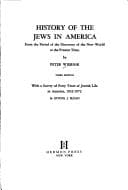
History of the Jews in America: From the Period of the Discovery of the New World to the Present Time — John Shaqi
History of the Jews in America: From the Period of the Discovery of the New World to the Present TimeWiernik, Peter
History
History of the Jews in America: From the Period of the Discovery of the New World to the Present Time
Wiernik, Peter
Jews -- America -- History; Jews -- United States -- History
But while the treatment was immeasurably better, the vicious principle
of separation remained. The Jews in Holland were as much a nation apart,
in theory at least, as in Spain and Portugal before the expulsion. They
did not enjoy the full rights of citizenship (until they received it,
somewhat against their will, during the French invasion at the end of
the eighteenth century) and were not even free from other restrictions.
They were not permitted to serve in the train bands or militia of the
cities, but paid a compensation for their exemption therefrom. The
prohibition of intermarriage with Christians could hardly be considered
a hardship for Jews of the seventeenth century; but the fact that they
were not allowed any mechanical pursuit or to engage in retail trade
has a much deeper significance. It explains, at least partly, why the
Dutch succeeded where the Portuguese failed, notably in that Indian
trade, whose interruption by the Turkish conquest of Constantinople
was the cause of searching new water routes to the East and of the
discovery of the New World.
Having exiled their best international traders and kept those
remaining as Marranos in constant terror, the Portuguese could not
derive the full benefit from that lucrative trade in spices which was
to be the reward of their great discoveries. When the sixty years’
captivity――as the domination of Spain over Portugal, from 1580 to
1640, is called――brought, among other disasters, the capture of the
Portuguese Indian possessions by the Dutch, the superiority of the
latter’s methods were soon apparent. They succeeded with more ease
“since, with true commercial spirit, they not only imported merchandise
from the East to Holland, but also distributed it through Dutch
merchants to every country in Europe; whereas the Portuguese in the
days of their commercial monopoly were satisfied with bringing over
the commodities to Lisbon and letting foreign nations come to fetch
them.” It is not difficult to surmise who were those Dutch merchants
who distributed the spices to every country in Europe, when we think
of that class of wealthy Marrano immigrants in Holland who were not
permitted to follow mechanical pursuits or to engage in retail trade.
Holland’s tendency was clearly apparent. The Jews, mostly Portuguese,
were permitted to use their wealth, their abilities and their foreign
connections to carry on and extend that trade which languished in the
hands of those who banished them. The Jews were exceedingly grateful
for the opportunity which Holland afforded them to be useful to
themselves and to her, and the very effective results of the friendship
between the Jews and the Dutch were soon apparent in the ensuing
struggle between the latter and the Portuguese over the possession of
Brazil.
Public-domain text, read in full here on John Shaqi.
Reviews
Reviews
No reviews yet
Be the first to share your thoughts on this work.
Join the Discussion
Join the discussion
Sign in to leave a comment or review.
Sign InorCreate an account