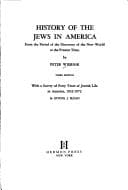
History of the Jews in America: From the Period of the Discovery of the New World to the Present TimeWiernik, Peter
History
History of the Jews in America: From the Period of the Discovery of the New World to the Present Time
Wiernik, Peter
Jews -- America -- History; Jews -- United States -- History
The Dutch commenced the realization of their ambitious scheme for the
conquest of Brazil in the second decade of the seventeenth century,
at a time when the large number of Marranos who lived there were
terrorized by rumors of the introduction of the inquisition. These
rumors became current as early as 1610, when it was reported that the
physicians of Bahia, who were mainly new-Christians, prescribed pork
to their patients in order to lessen the suspicion that they were still
adhering to Judaism. In connection with some of the earliest Brazilian
intrigues in favor of the Dutch, mention is made of one Francisco
Ribiero, a Portuguese captain, who is described as having many Jewish
relatives in Holland. About 1618 the Inquisition in Oporto, Portugal,
had arrested all merchants of Jewish extraction. Many of the victims
were engaged in Brazilian trade, and the Inquisitor-General applied
to the government to assist the Holy Office to recover such parts
of their effects as might be in the hands of their agents in Brazil.
Accordingly, Don Luis de Sousa was charged to send home a list of
all the new-Christians in Brazil “with the most precise information
that can be obtained of their property and place of abode.” It seems
highly probable that it was the Dutch war alone which prevented the
introduction of the dreaded Tribunal in Brazil.
The Dutch West India Company, which was formed in 1622 in furtherance
of the project of conquering Brazil, had Jews of Amsterdam among its
large stockholders, and several of them in its Board of Directors. One
of the arguments in favor of its organization was “that the Portuguese
themselves――some from their hatred of Castille, others because of their
intermarriage with new-Christians and their consequent fear of the
Inquisition――would either willingly join or feebly oppose an invasion,
and all that was needful was to treat them well and give them liberty
of conscience.”
When the Dutch fleet was sent to Bahia all the necessary information
was obtained from Jews. The city was taken in 1624 and Willeken,
the Dutch commander, at once issued a proclamation offering liberty,
free possession of their property and free enjoyment of religion to
all who would submit. This brought over about two hundred Jews, who
exerted themselves to induce others to follow their example. Bahia
was re-captured by the Portuguese in 1625, and though the treaty for
its deliverance provided for the safety of the other inhabitants, the
new-Christians were abandoned and five of them were put to death. Many
others, however, seemed to have remained there for several years.
Public-domain text, read in full here on John Shaqi.
Reviews
Reviews
No reviews yet
Be the first to share your thoughts on this work.
Join the Discussion
Join the discussion
Sign in to leave a comment or review.
Sign InorCreate an account