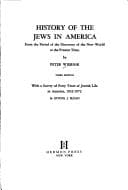
History of the Jews in America: From the Period of the Discovery of the New World to the Present Time — John Shaqi
History of the Jews in America: From the Period of the Discovery of the New World to the Present TimeWiernik, Peter
History
History of the Jews in America: From the Period of the Discovery of the New World to the Present Time
Wiernik, Peter
Jews -- America -- History; Jews -- United States -- History
When a French squadron attacked Surinam in 1689, the Jews under
the leadership of Samuel Nassi did good service in beating them
off. Similar valuable service was rendered in 1712, this time under
Capitein Isaac Pinto, against another French attack under Cassard.
The unfriendliness of the French was demonstrated again in that year,
when they took the Jewish Savannah and desecrated the Synagogue by
slaughtering a pig on the “Teibah” or Ammud. The Jews, on the other
hand, did not always get the protection to which they were entitled.
When the slaves on the plantation of M. Machado revolted and killed
their master in 1690, Governor Van Scherpenhuitzen refused to assist
the Jews. At a later period (in 1718), when there was continual trouble
with bush negroes, who destroyed the plantation of David Nassi, they
were chastised by Jews under the leadership of Capitein Jacob d’Avilar.
David Nassi (1672–1743) himself served under him with distinction, and
his praises were sung by the Judeo-Spanish poetess Benvenide Belmonte.
We also find traces of legal restrictions in such instances as the
decree of 1703, by which all Jewish marriages contracted in Surinam
up to that year are confirmed, but henceforth they must be made in
conformity with the Dutch marriage law of 1580. Sunday-closing laws
were also brought into force against them, but they were later repealed.
A list of the names of about sixty-five plantations belonging to
Jews at that period and the names of the owners has been preserved.
(“Publications,” IX, p. 129 ff.) Some of the plantations bear Hebrew
names like Carmel, Hebron, Succoth and Beer-Sheba. The number of Jews
in Surinam was then (about 1694) 570, consisting of ninety-two Dutch
or Portuguese families, about fifty unmarried persons and ten or twelve
German families. They possessed about nine thousand slaves.
Difficulties between the earlier settlers and the Germans, who arrived
later, soon arose, and in 1734 the latter requested permission to form
a separate community, which was granted. They were, however, prohibited
to own any possession on the Jewish Savannah, nor were they allowed
to have their own jurisdiction. The act of the separation of the
“Hoogduytsche” (High-German) Jews, who founded the congregation Neweh
Shalom, is dated January 5, 1735. It is signed by A. Henry de Scheusses
(Governor) and Samuel Uz. Davilar, Ishac Carrilho, Abraham Pinto
Junior, Jehoshuah C. Nassi, for the Portuguese; Solomon Joseph Levie,
I. Meyer Wolff, Gerrit Jacobs, Jakob Arons Polak for the German Jews.
The Portuguese thereupon built a new Synagogue, “Zedek we-Shalom,”
which was dedicated in 1737. But the Germans also stuck to the
Portuguese Minhag or prayer-book, and we have it on the authority of
Rabbi Roos of Paramaribo (1905) that there never existed a Synagogue
with the Minhag Ashkenaz in Surinam.
Public-domain text, read in full here on John Shaqi.
Reviews
Reviews
No reviews yet
Be the first to share your thoughts on this work.
Join the Discussion
Join the discussion
Sign in to leave a comment or review.
Sign InorCreate an account