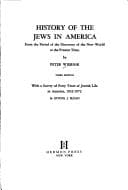
History of the Jews in America: From the Period of the Discovery of the New World to the Present Time — John Shaqi
History of the Jews in America: From the Period of the Discovery of the New World to the Present TimeWiernik, Peter
History
History of the Jews in America: From the Period of the Discovery of the New World to the Present Time
Wiernik, Peter
Jews -- America -- History; Jews -- United States -- History
Bloody conflicts with negroes continued for about forty years longer,
and many valiant deeds of Jewish military leaders and their followers
embellish the records of that period. David Nassi was killed in battle
at the age of 71 (in 1743), after being successful in more than thirty
skirmishes, and was succeeded as capitein by Isaac Carvalho. In 1749
another Jewish capitein, Naär, won a victory against the Auka negroes;
while in 1750 young Isaac Nassi and three hundred of his men were
killed by an overwhelming force of bush negroes. At last, in 1774,
forts were erected and a military line drawn from the Savannah of the
Jews along the river Commoimber to the sea; and we hear no more of
negro wars.
The legal status of the Jews was undergoing some changes, as is almost
unavoidable so long as there is not the same law for Jew and Gentile
alike. Some measures could be considered as improvements, like the
law of 1749, which granted the Jews of Surinam their own judiciary in
matters affecting less than 600 gulden. On the other hand we hear of
an unsuccessful attempt in 1768 to institute a Ghetto in Paramaribo,
and in 1775 Jews were forbidden to visit a certain amateur theatre
of that town. At that time the two communities also began to make
use of the right which was bestowed on them by the English Charter of
Privilege (and later confirmed by the Dutch authorities), of “banishing
troublesome people and persons of bad demeanour.” The “Deputies of
the Jewish Nation” had only to declare to the Governor the reasons why
they wished to have these persons banished, and they were expelled. The
above named Rabbi J. S. Roos has noted five cases of such banishments:
Solomon Montel was banished in 1761 on the request of the Portuguese
deputies, because he refused to restitute rents or usury “which is
contrary to the Mosaic law.” In 1772 ♦Noah Isaaks was banished on
the request of the German deputies, and in the following year Abraham
Isaac Moses Michael Fernandes Henriques, alias Escarabajos, was, on the
request of the Portuguese deputies, made to quit the place. Elias Levin
was banished in 1781 by the Germans and Abraham de Mesquita, the last
of those exiled, belonged to the Portuguese part of the community.
The German Jews kept on increasing in numbers, and in 1780 their
Synagogue in Paramaribo was enlarged and two burial grounds were
procured. In 1784 the Jewish theatre of that city, probably the first
in modern history, was enlarged and embellished. The Savannah, of
which only ruins remain now, was on its decline, and had only about
forty houses in 1792; while the community in Paramaribo was growing
and two Jewish play houses are mentioned in that year. The Portuguese
were still the majority, numbering 834, but the Germans were gaining
fast, and from the ten families at the end of the seventeenth century
they rose now to the number of 477. There were also about 100 Jewish
mulattoes in Paramaribo in that time.
Public-domain text, read in full here on John Shaqi.
Reviews
Reviews
No reviews yet
Be the first to share your thoughts on this work.
Join the Discussion
Join the discussion
Sign in to leave a comment or review.
Sign InorCreate an account