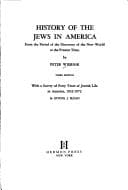
History of the Jews in America: From the Period of the Discovery of the New World to the Present TimeWiernik, Peter
History
History of the Jews in America: From the Period of the Discovery of the New World to the Present Time
Wiernik, Peter
Jews -- America -- History; Jews -- United States -- History
The Jewish community was soon increased to a considerable extent,
partly by the arrival of former members of the dissolved colony of
Cayenne (1664). It is recorded in the minutes of the vestry of St.
Michael’s Parish (July 9, 1666) “that the Jews inhabiting this Parish
do pay the quantity of 35,000 pounds Muscovado sugar, to be levied by
themselves and paid to Senior Lewis Dias and Senior Jeronimo Roderigos,
who are hereby ordered to pay it to the present church wardens.” The
order is repeated in October, 1666, and again in 1667; and in that
year another order making the levy for the year 20,000 pounds was
issued. In 1669 the order in January was for 14,000 pounds, and in
March for 16,000. In 1670 it was again for 16,000, but the Jews sent
in a petition declaring the amount to be excessive. This had the effect
of reducing the amount of the tax to 7,000 pounds in 1671 and to “half
of what was levied last year” in 1672. For the following five years it
was mostly 7,000 pounds a year, “levied for their trade.” In 1680 it
is 8,500 pounds, apportioned among forty-five Jews, some being made to
contribute only twelve pounds, several others as high as 792 each, with
David Raphael de Mercado heading the list with 1,075 pounds. (See list
of names in “Publications,” XIX, pp. 174–75.)
Antonio Rodrigo Rigio, Abraham Levi Regio, Lewis Dias, Isaac Jerajo
Coutinho, Abraham Pereira, David Baruch Louzada and other Hebrews who
were made free denizens by His Majesty’s letters patent, petitioned in
1669 about the refusal to accept the testimony of Jews in the courts of
the colony. The governor, in forwarding the petition, says, that “they
had not been exposed to any other injuries in their trade or otherwise.”
But the privilege granted was only for cases “relating to trade and
dealing.” Special taxes continued to be imposed at various times until
1761, when all additional burdens were lifted, and afterward the Jews
were rated and paid taxes on the ♦same scale as other inhabitants. All
political disabilities were removed by act of the local government in
1802, and by act of Parliament in 1820.
The number of Jews in Barbadoes was never as large as that of Surinam.
In 1681 the total Jewish population of the island was 260. They went
on increasing slowly, the great majority living in Bridgetown (where
the first Synagogue was erected, probably prior to 1679) and a small
number in Speightstown. In 1792, at the beginning of the period of the
greatest prosperity of the community, the congregation of Bridgetown
had 147 members, and 17 pensioners were supported. The name of the
congregation was “Kehol Kodesh Nidhe Israel,” and its ministers were
all selected by the vestry of the Spanish and Portuguese Synagogue in
London.
Public-domain text, read in full here on John Shaqi.
Reviews
Reviews
No reviews yet
Be the first to share your thoughts on this work.
Join the Discussion
Join the discussion
Sign in to leave a comment or review.
Sign InorCreate an account