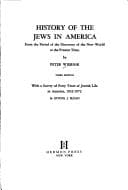
History of the Jews in America: From the Period of the Discovery of the New World to the Present TimeWiernik, Peter
History
History of the Jews in America: From the Period of the Discovery of the New World to the Present Time
Wiernik, Peter
Jews -- America -- History; Jews -- United States -- History
The Jewish settlements in the British West Indies also enjoyed long
periods of increase and prosperity; but they declined when the English
colonies of the North American continent, and later, the United States,
offered a wider field of activities and better opportunities under
conditions which were so similar to those prevailing in the older
places as to make the change of residence a matter of very little
inconvenience. The oldest settlement under the English flag in the West
Indies was probably on the island of Barbadoes, where, it is believed,
Jews came first in 1628. On April 27, 1655, Oliver Cromwell issued
passes to Abraham de Mercado, M. D., Hebrew, and his son, Raphael,
to go to Barbadoes to exercise his profession. In 1656 the Jews were
granted, upon petition, the enjoyment of the privileges of the laws and
statutes of the Commonwealth of England and of the Island relating to
foreigners and strangers.
In April, 1661, Benjamin de Caseres, Henry de Caseres and Jacob
Fraso petitioned the King of England to permit them to live and trade
in Barbadoes and Surinam. Their petition was supported by the King
of Denmark, which tends to prove that they must have been men of
considerable importance. In the report made by the Commissioners of
Foreign Plantations, to whom it was referred, it is stated that the
whole question of the advisability of allowing Jews to reside in and
trade with his majesty’s colonies “hath been long and often debated.”
The merchants of England were opposed to the admission of Jews, because
of their ability to control trade wherever they entered, and because
they would divert it from England to foreign countries. The planters,
on the contrary, favored their admission and accused the merchants of
aiming to appropriate the whole trade to themselves. The commissioners
refrained from deciding the general question, but advised that these
three highly recommended Jews, who had behaved themselves well and with
general satisfaction in Barbadoes, should be granted a special license
to reside there or in any other plantations.
Public-domain text, read in full here on John Shaqi.
Reviews
Reviews
No reviews yet
Be the first to share your thoughts on this work.
Join the Discussion
Join the discussion
Sign in to leave a comment or review.
Sign InorCreate an account