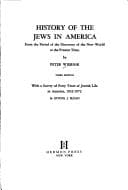
History of the Jews in America: From the Period of the Discovery of the New World to the Present TimeWiernik, Peter
History
History of the Jews in America: From the Period of the Discovery of the New World to the Present Time
Wiernik, Peter
Jews -- America -- History; Jews -- United States -- History
Several years before that time Jacob Joshua Bueno Enriques, a resident
of Jamaica for two years, petitioned the King for permission to work
a copper mine, and that he and his brothers, Josef and Moise, “may use
their own laws and hold Synagogues.” In 1668 Solomon Gabay Faro and
David ♦Gomez Henriques were recommended by the King to the governor
to remain and trade in Jamaica as long as they behaved well and fairly.
There were considerable increases by arrivals from Brazil, later from
the withdrawal of the British from Surinam, by direct immigration
from England and even from Germany. But there must have been also
considerable emigration of Jews, for at the end of the seventeenth
century the number of Jews in Jamaica is figured at eighty. While the
inclusion of Hebrew in the curriculum of the free school which was
established in the Parish of St. Andrews in 1693――the earliest known
instance of the teaching of Hebrew in an English settlement in the
New World――may be taken as a concession to the Jewish inhabitants,
there was no lack of harsh and galling measures. In 1703 the Jews
were prohibited, under penalty of five hundred pounds, from holding
Christian servants. In 1711 they were prohibited, along with mulattoes,
Indians and negroes, from being employed as clerks in any of the
judicial or other offices.
The struggle of the Jews of Jamaica against heavy taxation forms an
interesting chapter in their history at the beginning of the eighteenth
century. (See “Publications” II, p. 165 ff.) In 1700 a memorial was
presented to Sir William Beeston, Governor-in-Chief of the Island of
Jamaica, against the excessive special taxation of four assemblies,
and against “being forced to bear arms on our Sabbath and holy days ...
without any necessity or urgent occasion (which is quite contrary to
our religion, unless in case of necessity, when an enemy is in sight or
apprehension of being near us).” The reply by the governor and council
begins with the admission of the truth of the statement about taxation;
but a counter-claim is advanced that “their first introduction into
this island was on the condition that they should settle and plant,
which they do not, there being but one considerable and two or three
small settlements of the Jews in all the island. But their employment
is generally keeping of shops and merchandise, by the first of which
they have engrossed that employment, and by their parsimonious living
(which I do not charge as a fault in them) they have thereby means of
underselling the English; that they cannot, many in them, follow that
employment, nor can they in reason put their children to the Jews to be
trained up in that profession, by which the English nation think they
suffer much, both in their own advantages and what may be made to their
children hereafter.”
Public-domain text, read in full here on John Shaqi.
Reviews
Reviews
No reviews yet
Be the first to share your thoughts on this work.
Join the Discussion
Join the discussion
Sign in to leave a comment or review.
Sign InorCreate an account