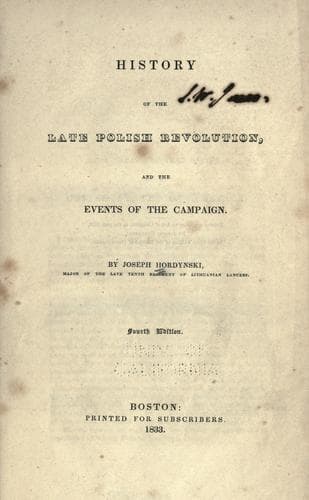
History of the Late Polish Revolution and the Events of the CampaignHordynski, Joseph
History
History of the Late Polish Revolution and the Events of the Campaign
Hordynski, Joseph
Poland -- History -- Revolution, 1830-1832
'Olgerd was the most powerful of the sovereigns of Lithuania.
The republic of Pskow, in 1346, and that of Nowogorod, in 1349,
acknowledged him for their master. In 1363, the Tartars of Pérékop
(Krimea,) became his vassals. On the east, embracing the cause of the
duke of Twer, he came three times, in 1368, 1370, 1373, to break his
lance against the ramparts of the city of Moscow; of that city where
at a later day the great generals of Poland and of Lithuania, and at
last, in 1812, the Gallo-Polono-Lithuanian lances were crossed in
front of the superb Kremlin! Kiegstut powerfully seconded his brother
in his conquests. It was under such auspices that Olgerd, descending
to the tomb, left his brilliant inheritance to Jagellon, one of his
thirteen sons. Jagellon, who ascended the grand-ducal throne in 1381,
ceded it to his cousin Witold, in 1386, when he went to place upon his
head the crown of the Piasts, to unite his hand to that of Hedwige,
and to cement forever the glorious junction of Lithuania and Poland.
In 1389, he gave the government of the duchy of Sévérie-Nowogorodien
and the republic of Nowogorod-the-Great to his two brothers; while on
the other side, his cousin Witold, being attacked in his new conquests
by the Tartars, beat them, chased a part of them beyond the Don, and
transported those who fell into his hands into the different countries
of Lithuania, where, instead of reducing them to slavery, he gave them
possessions, with the liberty of freely exercising their religious
rights. It was the descendants of those Tartars who showed themselves
such worthy children of their adopted country, at the epoch of the war
of independence, in 1794, and in the campaign of 1812. In this manner
Witold acquired the possession, not only of the Russian territories,
delivered from the yoke of the Tartars by his grandfather and his
uncle, but those which were held by the other small Trans-Borysthenian
Czars. Turning then his victorious army to the north, he forced the
northern republics, whose fidelity he suspected, to humble themselves
before him, and recognize his unqualified supremacy. In fine, Poland
and Lithuania arrived, at that epoch, to such a degree of power, that
the dukes of Mazovia and Russia, the Czars of Moscow, Basile, that of
Twer Borys, that of Riezan, Olegh, the little Czars of Pérékop and
Volga, the Teutonic masters, the Prussians and Livonians, in fine,
the emperor of Germany, Sigismond himself, accompanied by his wife,
and several princes, Erik, king of Denmark and Sweden, as well as
the ambassadors of the emperor of the East, Paleogogus, presented
themselves to Wladislas-Jagellon at Luck, in Volhynia, and held there
a general congress in 1428, in which they deliberated upon the war
against the Ottomans; and at which the emperor of Germany attempted
in vain, by means of intrigues, to throw some seeds of dissension
between Jagellon and Witold. Witold died in 1430. Kasimir le Jagellon,
Public-domain text, read in full here on John Shaqi.
Reviews
Reviews
No reviews yet
Be the first to share your thoughts on this work.
Elsewhere in the archive
Join the Discussion
Join the discussion
Sign in to leave a comment or review.
Sign InorCreate an account