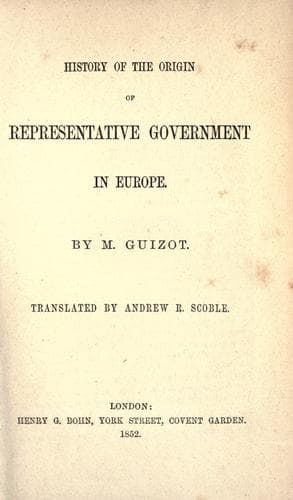
History of the Origin of Representative Government in EuropeGuizot, François
History
History of the Origin of Representative Government in Europe
Guizot, François
Europe -- History; Representative government and representation
Such was the condition of the Franco-Roman community, at the
period which we are considering. It seems somewhat puerile to
inquire who was free then; no one was free, whatever his origin
might be, if he was not strong. The real inquiry is, who was
strong--a point which it is exceedingly difficult to determine.
In a fully settled society which has existed for a long time, it
is easy to know who is strong. There is a constant transmission
of properties and of ancient influences; power has permanent
forms, men are classified. We see where strength resides and who
possesses it. But at the time which we are considering, the
various elements of social strength were struggling into
existence;--they scarcely had a being, and they were not
familiarly known, nor stably fixed, or in regular possession of
power;--the violent customs which prevailed rendered property
very moveable;--individual strength was a poor guarantee for
liberty, indeed, it needed itself to be placed in guardianship.
The human mind can hardly believe in disorder, because it cannot
picture clearly to itself such a state of things; it does not
resign itself to the idea; it desires to introduce an order of
its own, in order to discover the light. We must, however, accept
facts as they actually are. We may therefore understand how
difficult it is to exhibit the condition of men, from the fifth
to the tenth centuries; to learn what men were free, and who were
not, and especially what a free man really was in his position
and influence. We shall understand this difficulty still better
when we have attempted to determine the condition of life
belonging to certain positions, according to the different
principles of classification which we may bring to the task. We
shall see that no one principle can be found, by which we can
deduce the state belonging to different positions in a manner
exactly conformable to known facts, and which is not contradicted
at every step by these same facts, or at least shown by them to
be utterly insufficient and untrustworthy.
Let us first apply the principle which is inferred from the state
of landed property.
{135}
Allodial And Beneficiary Proprietors.
The proprietors of allods might seem to be incontestably free
men. An allodial proprietor who had extensive estates enjoyed
complete independence, and wielded an almost absolute sovereignty
throughout his territory, and among his associates.
Public-domain text, read in full here on John Shaqi.
Reviews
Reviews
No reviews yet
Be the first to share your thoughts on this work.
Elsewhere in the archive
Join the Discussion
Join the discussion
Sign in to leave a comment or review.
Sign InorCreate an account