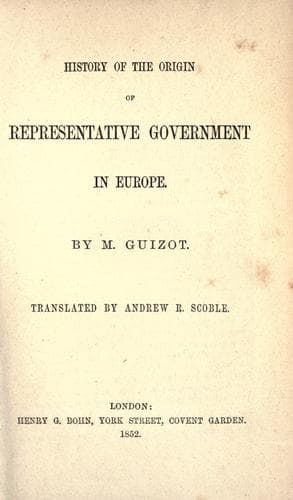
History of the Origin of Representative Government in EuropeGuizot, François
History
History of the Origin of Representative Government in Europe
Guizot, François
Europe -- History; Representative government and representation
3. Laws without either date or author's name, which seem to
have been literally copied from the various collections of laws
successively compiled by Euric, Leovigild, Recared,
Chindasuinth, and other kings.
4. Lastly, laws entitled _antiqua noviter emendata_, which
were mostly borrowed from the Roman laws, as is formally
indicated by their title in some manuscripts.
The _Forum judicum_, as we possess it at the present day, is
a code formed of the collection of all these laws, as finally
collected, revised, and arranged at the sixteenth council of
Toledo, by order of King Egica. The most ancient Castilian
version of the _Forum judicum_ appears to have been made
during the reign of Ferdinand the Saint (1230-1252).
{217}
Visigothic Theory Of Law.
Legislation is almost always imperative; it prescribes or
interdicts; each legal provision usually corresponds to some fact
which it either ordains or prohibits. Rarely does it happen that
a law, or code of laws, are preceded by a theory on the origin
and nature of power, the object and philosophic character of law,
and the right and duty of the legislator. All legislations
suppose some solution or other to these primary questions, and
conform thereto; but it is by a secret bond, frequently unknown
to the legislator himself. The law of the Visigoths has this
singular characteristic, that its theory precedes it, and is
incessantly recurrent in it--a theory formally expressed, and
arranged in articles. Its authors wished to do more than ordain
and prohibit; they decreed principles, and converted into law
philosophical truths, or what appeared to them to be such.
This fact alone indicates that the _Forum judicum_ was the
work of the philosophers of that period; I mean, the clergy.
Never did such a proceeding occur to the mind of a new people,
still less to a horde of Barbarian conquerors. Assuredly a
doctrine which thus serves as preface and commentary to a code,
merits our best attention.
"The law," says the _Forum judicum_, "is the emulator of
divinity, the messenger of justice, the mistress of life. It
regulates all conditions in the State, all ages of human life;
it is imposed on women as well as on men, on the young as well
as on the old, on the learned as well as on the ignorant, on
the inhabitants of towns as well as on those of the country; it
comes to the aid of no particular interest; but it protects and
defends the common interest of all citizens. It must be
according to the nature of things and the customs of the State,
adapted to the time and place, prescribing none but just and
equitable rules, clear and public, so as to act as a snare to
no citizen."
Public-domain text, read in full here on John Shaqi.
Reviews
Reviews
No reviews yet
Be the first to share your thoughts on this work.
Elsewhere in the archive
Join the Discussion
Join the discussion
Sign in to leave a comment or review.
Sign InorCreate an account