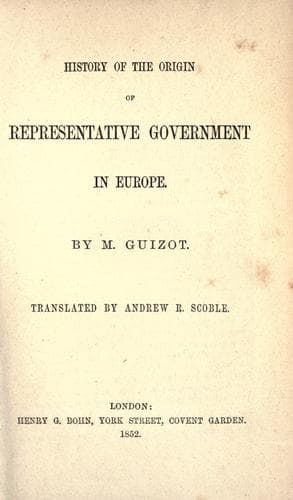
History of the Origin of Representative Government in EuropeGuizot, François
History
History of the Origin of Representative Government in Europe
Guizot, François
Europe -- History; Representative government and representation
In these ideas on the nature and object of written law, the
fundamental idea of the theory is revealed. There is an
unwritten, eternal, universal law, fully known to God alone, and
which the human legislator seeks after. Human law is good only in
so far as it is the _emulator_ and _messenger_ of the
divine law. The source of the legitimacy of laws is, then, not to
be found on earth; and this legitimacy originates, not in the
will of him or them who make the laws, whoever they may be, but
in the conformity of the laws themselves to truth, reason, and
justice--which constitute the true law.
{218}
All the consequences of this principle were certainly not present
to the mind of the Spanish bishops, and many of the consequences
which they deduced were very false; but the principle was there.
They deduced from it this other principle, then unknown to
Europe, that the character of law is to be universal, the same
for all men, foreign to all private interests, given solely for
the common interest. On the other hand, it was the character of
the other Barbarian codes that they were conceived for the
furtherance of the private interests, either of individuals or of
classes. Thus the whole system of laws, whether good or bad,
which issued therefrom, bore this imprint; it was a system of
privileges, _privatæ leges_. The councils of Toledo alone
attempted to introduce into politics the principle of equality in
the sight of the law, which they derived from the Christian idea
of equality in the sight of God. Thus, the law of the Visigoths
was, at this period, the only one that could be called _lex
publica_.
Theory On The Nature Of Power.
From this theory on the nature of law, resulted the following
theory on the nature of power.
1. No power is legitimate except in so far as it is just, as it
governs and is itself governed by the true law, the law of
justice and truth. No human will, no terrestrial force can
confer on power an external and borrowed legitimacy; the
principle of its legitimacy resides in itself and in itself
alone, in its morality and its reason.
2. All legitimate power comes from above. He who possesses and
exercises it, holds it solely by reason of his own intellectual
and moral superiority. This superiority is given to him by God
himself. He does not, therefore, receive power from the will of
those over whom he exercises it; he exercises it legitimately,
not because he has received it, but because he possesses it in
himself. He is not a delegate or a servant, but a superior, a
chief.
Public-domain text, read in full here on John Shaqi.
Reviews
Reviews
No reviews yet
Be the first to share your thoughts on this work.
Elsewhere in the archive
Join the Discussion
Join the discussion
Sign in to leave a comment or review.
Sign InorCreate an account