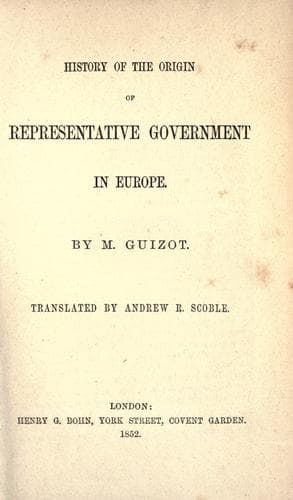
History of the Origin of Representative Government in EuropeGuizot, François
History
History of the Origin of Representative Government in Europe
Guizot, François
Europe -- History; Representative government and representation
The first of the great external characteristics of representative
government, division of power, is met with in every age, in the
government of England. Never was the government concentrated in
the hands of the king alone; under the name of the
_Wittenagemot_, of the _Council or Assembly of the
Barons_, and after the reign of Henry III., of the
_Parliament_, a more or less numerous and influential
assembly, composed in a particular manner, was always associated
with the sovereignty. For a long period, this assembly somewhat
subserved despotism, and sometimes substituted civil war and
anarchy in the place of despotism; but it always interfered in
the central government. An independent council, which derived its
strength from the individual power of its members, was always
adjoined to the royal authority. The English monarchy has always
been the government of the king in council, and the king's
council was frequently his adversary. The great council of the
king became the Parliament.
This is the only one of the essential characteristics of the
system of representative government, which the government of
England presents, until the fourteenth century. During the course
of this epoch, the division of power, far from efficiently
repressing despotism, served only to render it more changeful and
more dangerous.
{267}
The council of barons was no more capable than the king himself,
of comprehending and establishing a stable political order and
true liberty; these two forces were incessantly in conflict, and
their conflict was war, that is to say, the devastation of the
country, and the oppression of the mass of the inhabitants. But
from this there resulted, in process of time, two decisive facts,
from which liberty took its origin; they were these:
Public-domain text, read in full here on John Shaqi.
Reviews
Reviews
No reviews yet
Be the first to share your thoughts on this work.
Elsewhere in the archive
Join the Discussion
Join the discussion
Sign in to leave a comment or review.
Sign InorCreate an account