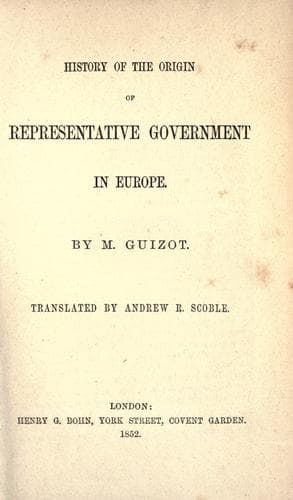
History of the Origin of Representative Government in EuropeGuizot, François
History
History of the Origin of Representative Government in Europe
Guizot, François
Europe -- History; Representative government and representation
1. From the very fact that power was divided, it followed that
absolute power, sovereignty as a right, was never attributed to
the king, nor supposed to be in itself legitimate. Now, this is
the very principle of representative government; but this
principle was far from being understood, or even suspected,
philosophically speaking. It was incessantly stifled by force,
or else it was lost in the confusion of the ideas of the time
regarding divine right, the origin of power, and so forth; but
it existed in the depths of the public mind, and became by slow
degrees a fundamental maxim. We find this principle formally
expressed in the writings of Bracton, Lord Chief Justice under
Henry III., and of Fortescue, who held the same office under
Henry VI. "The king," says Bracton, "should be subject to no
man, but only to God and to the law, for the law makes him
king; he can do nothing upon earth but that which, by law, he
may do; and that which is said in the Pandects, that that which
pleases the king becomes law, is no objection; for we see by
the context, that these words do not mean the pure and simple
will of the prince, but that which has been determined by the
advice of his councils, the king giving the sanction of his
authority to their deliberations upon the subject."
Character Of The English Monarchy.
"The English monarchy," says Fortescue, "_non solum est
regalis, sed legalis et politica, potestas,_" and he
frequently develops this idea. The limitation of powers was,
thus, at a very early period, a matter of public right in
England; and the legitimacy of sole and absolute power was
never recognized. Thus was established and preserved, for
better times, the generative principle of all legitimate power
as well as of all liberty; and by the virtue of this principle
alone was maintained, in the souls of the people, that noble
sentiment of right which becomes extinguished and succumbs
wherever man finds himself in presence of an unlimited
sovereignty, whatever may be its form and name.
{268}
Importance Of The Towns.
Public-domain text, read in full here on John Shaqi.
Reviews
Reviews
No reviews yet
Be the first to share your thoughts on this work.
Elsewhere in the archive
Join the Discussion
Join the discussion
Sign in to leave a comment or review.
Sign InorCreate an account