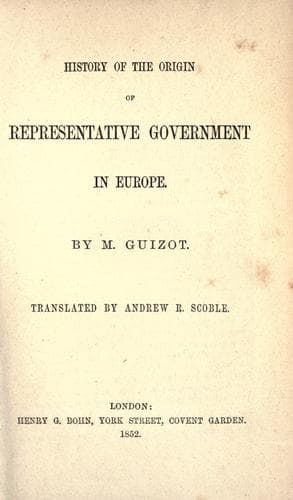
History of the Origin of Representative Government in EuropeGuizot, François
History
History of the Origin of Representative Government in Europe
Guizot, François
Europe -- History; Representative government and representation
Such was the pervading feeling, when (August 25, 1213) an
assembly of the barons was convened at London. In one of their
meetings, Cardinal Langton informed them that he had found a copy
of the charter of Henry I., which was then entirely forgotten;
this charter was read to the assembly, and received with
enthusiasm. Another meeting was held at Saint Edmundsbury
(November 20, 1214), and there each baron, laying his hand upon
the altar, took an oath that he would use his efforts to force
the king to restore in full vigour the charter of Henry I. They
soon presented themselves at London in arms, and on January 5,
1215, they demanded from John, in a formal and positive way, the
renewal of this charter, as well as of the laws of Edward the
Confessor. John, terrified by their firmness, requested that some
leisure might be granted to him in order to think over these
demands, and accordingly his answer was deferred till Easter.
During this interval, he endeavoured to introduce division among
his enemies, and in the first place, wishing to conciliate the
clergy, he granted them by a charter the liberty of electing
their own bishops and abbots, and sent William de Mauclerc to
Rome to complain of the audacity of the barons.
{312}
They too despatched Eustace de Vesci to Rome, to represent to the
pontiff the justice and sacredness of their cause. This embassy,
however, failed in its object; the Pope condemned the barons: but
they were not to be intimidated from their purposes, and John,
determining to make another effort in order to secure the support
of the church, took the cross on the 2nd of February, 1215, and
made a vow to lead an army into Palestine.
The respite, however, which the barons had granted to the king
came to an end, and they met again at Stamford in Lincolnshire,
on the 19th of April, 1215, being followed by nearly two thousand
knights in arms. The king asked them what their claims were; they
made at Stamford the same answer as they had made in London, and
presented the charter which they had sworn to establish. "And why
do they not demand my crown also?" exclaimed John in his fury;
"by God's teeth, I will not grant them liberties which will make
me a slave." This answer was taken as a declaration of war, and
on the 5th of May following, the barons met at Wallingford,
solemnly renounced their oath of allegiance, and at the same time
named Robert Fitz-Walter general of the "army of God and of Holy
Church."
Public-domain text, read in full here on John Shaqi.
Reviews
Reviews
No reviews yet
Be the first to share your thoughts on this work.
Elsewhere in the archive
Join the Discussion
Join the discussion
Sign in to leave a comment or review.
Sign InorCreate an account