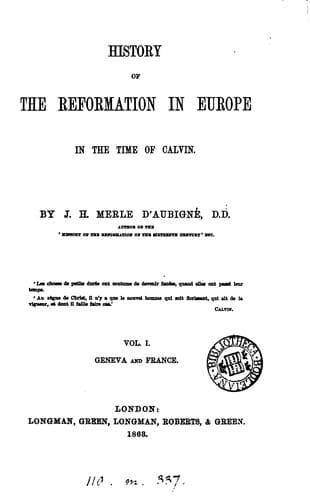
History of the Reformation in Europe in the Time of Calvin, Vol. 6 (of 8)Merle d'Aubigné, J. H. (Jean Henri)
History
History of the Reformation in Europe in the Time of Calvin, Vol. 6 (of 8)
Merle d'Aubigné, J. H. (Jean Henri)
Reformation
James, notwithstanding his imprudence, did not indulge in these foolish
illusions. He knew that Henry VIII. was much stronger than himself.
The blow which the wrath of his uncle had inflicted on him made him
turn from left to right. He wished to take advantage of the petty
victory of Halidon for making peace with England. Persecution ceased in
Scotland, and liberty of conscience was more liberally granted. On the
day after the engagement, and before James was informed of the result,
he had already written to Henry, and had asked him for passports for
his plenipotentiaries. On September 1 he wrote to him again: ‘We assure
you, dearest uncle,’ said he, ‘there is within our realm neither of
spiritual nor temporal state that may or shall change our favor and
kindness toward you.’[249] But Henry was not of such an easy temper:
he bore in mind the affront at York, and he intended to avenge it.
He forbade the ambassadors of his nephew to pass beyond that city.
During this time he was collecting all kinds of munitions of war, and
in very large quantities. He assembled an army such as Scotland had
not for a long time seen at her borders, and gave the command of it to
that duke of Norfolk who was to defeat the son as he had defeated the
father. The King of England wanted also to be the king of Scotland,
and wished that the whole of Great Britain should belong to the same
prince. This dream was one day to be realized, but with this great
difference, that it would not be the King of England who should become
king of Scotland, but the King of Scotland who should become king of
England. We find in the State Papers the following despatch, addressed
by the English privy council to the archbishop of York:--‘Minding to
have the king’s majesty’s title to the realm of Scotland more fully,
plainly, and clearly set forth to all the world, that the justness of
our quarrel and demand may appear, we have appointed certain learned
men to travail in the same. And for because we knew that your lordship
in times past hath taken some pains in the same thing, we pray you not
only to cause all your old registers and ancient places to be sought,
where you think anything may be found for the more clear declaration
to the world of his majesty’s title to that realm, and so what shall
be found to certify us thereof accordingly; but also to signify unto
us what ancient charters and monuments for that purpose you have seen,
and where the same are to be sought for.’ For having failed to make the
promised visit, James must lose his crown. Once let the King of England
have possessed himself of Scotland (thanks to his soldiers, without
doubt, more than to his charters and muniments), he would banish popery
and establish his own bishops in its place, and above all his own
papacy.
Public-domain text, read in full here on John Shaqi.
Reviews
Reviews
No reviews yet
Be the first to share your thoughts on this work.
Elsewhere in the archive
Join the Discussion
Join the discussion
Sign in to leave a comment or review.
Sign InorCreate an account