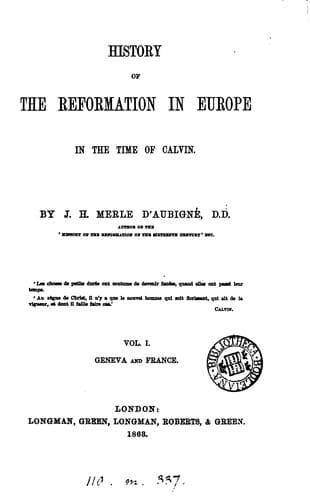
History of the Reformation in Europe in the Time of Calvin, Vol. 6 (of 8) — John Shaqi
History of the Reformation in Europe in the Time of Calvin, Vol. 6 (of 8)Merle d'Aubigné, J. H. (Jean Henri)
History
History of the Reformation in Europe in the Time of Calvin, Vol. 6 (of 8)
Merle d'Aubigné, J. H. (Jean Henri)
Reformation
IN THE TIME OF CALVIN.
BOOK X.
THE REFORMATION IN SCOTLAND.
CHAPTER I.
PREPARATION OF REFORM.
(FROM THE 2ND CENTURY TO THE YEAR 1522.)
History is of various kinds. It may be literary, philosophical,
political, or religious; the last entering most deeply into the inmost
facts of our being. The political historian will sometimes disclose
the hidden mysteries of the cabinets of princes, will fathom their
counsels, unveil their intrigues, and snatch their secrets from a
Cæsar, a Charles V., a Napoleon, while human nature in its loftiest
aspects remains inaccessible to them. The inward power of conscience,
which not seldom impels a man to act in a way opposed to the rules of
policy and to the requirements of self-interest, the great spiritual
evolutions of humanity, the sacrifices of missionaries and of martyrs,
are for them covered with a veil. It is the Gospel alone which gives
us the key of these mysteries, so that there remain in history, even
for the most able investigators, enigmas which appear insoluble. How
is it that schemes conceived with indisputable cleverness fail? How is
it that enterprises which seem insane succeed? They cannot tell. No
matter, they keep on their way, they pass into other regions and leave
behind them territories which have not been explored.
This is to be regretted, for the historian ought to embrace in his
survey the whole field of human affairs. He must, of course, take
into consideration the earthly powers which bear sway in the world,
ambition, despotism, liberty; but he ought to mark also the heavenly
powers which religion reveals. The living God must not be excluded from
the world which He created. Man must not stop in his contemplations
at elementary molecules, nor even at political influences, but must
raise himself to this first principle, as Clement of Alexandria named
it,--this existence, the idea of which is immediate, original, springs
from no other, but is necessarily presupposed in all thought.
Public-domain text, read in full here on John Shaqi.
Reviews
Reviews
No reviews yet
Be the first to share your thoughts on this work.
Join the Discussion
Join the discussion
Sign in to leave a comment or review.
Sign InorCreate an account