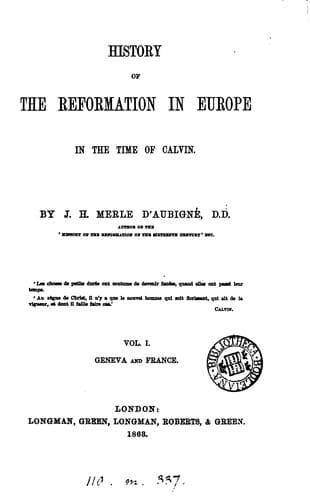
History of the Reformation in Europe in the Time of Calvin, Vol. 6 (of 8)Merle d'Aubigné, J. H. (Jean Henri)
History
History of the Reformation in Europe in the Time of Calvin, Vol. 6 (of 8)
Merle d'Aubigné, J. H. (Jean Henri)
Reformation
God, who renews the greenness of our pastures, who makes the corn come
forth out of the bosom of the earth, and covers the trees with blossoms
and with fruit, does not abandon the souls of men. The God of the whole
visible creation is much more the light and the strength of souls, for
one of these is more precious in his sight than all the universe. The
Creator, who every spring brings forth out of the winter’s ice and cold
a nature full of life, smiling with light and adorned with flowers, can
assuredly produce, when it pleases Him, a spiritual springtide in the
heart of a torpid and frozen humanity. The Divine Spirit is the sap
which infuses into barren souls the vivifying juices of heaven. The
world has not seldom been like a desert in which all life seemed to be
extinct; and yet, in those periods apparently so arid, subterranean
currents were yielding sustenance here and there to solitary plants;
and at the hour fixed by Divine providence the living water has gushed
forth abundantly to reanimate perishing humanity. Such was the case in
the two greatest ages of history, that of the Gospel and that of the
Reformation.
[Sidenote: THE SPIRITUAL SPRINGTIDE.]
Such epochs, the most important in human history, are for that reason
the worthiest to be studied. The new life which sprang up in the 16th
century was everywhere the same, but nevertheless it bore a certain
special character in each of the countries in which it appeared; in
Germany, in Switzerland, in England, in Scotland, in France, in Italy,
in the Netherlands, in Spain, and in other lands. At Wittenberg it
was to man that Christian thought especially attached itself, to
man fallen, but regenerated and justified by faith. At Geneva it
was to God, to His sovereignty and His grace. In Scotland it was to
Christ--Christ as expiatory victim, but above all Christ as king, who
governs and keeps his people independently of human power.
Scotland is peopled by a vigorous race, vigorous in their virtues
and vigorous, we may add, in their faults. Vigor is also one of the
distinguishing features of Scottish Christianity, and it is this
quality perhaps which led Scotland to attach itself particularly to
Christ as to the king of the Church, the idea of power being always
involved in the idea of king.
This country is now to be the subject of our narrative. It deserves to
be so; for although of small extent and situated on the confines of the
West, it has by nature and by faith a motive force which makes itself
felt to the ends of the earth.
Two periods are to be noted in the Scottish Reformation, that of
Hamilton and that of Knox. It is of the first of these only that we
are now to treat. The study of the beginnings of things attracts and
interests the mind in the highest degree. Faithful to our plan, we
shall ascend to the generative epoch of Caledonian reform, an epoch
which Scotland herself has perhaps too much slighted, and we shall
exhibit its simple beauty.
Public-domain text, read in full here on John Shaqi.
Reviews
Reviews
No reviews yet
Be the first to share your thoughts on this work.
Join the Discussion
Join the discussion
Sign in to leave a comment or review.
Sign InorCreate an account