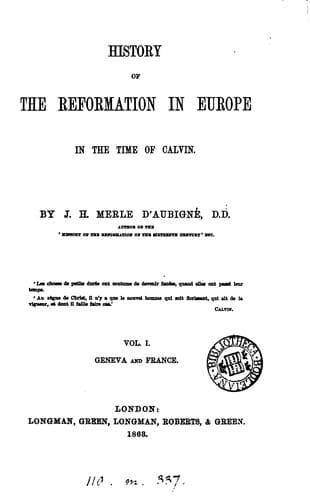
History of the Reformation in Europe in the Time of Calvin, Vol. 6 (of 8)Merle d'Aubigné, J. H. (Jean Henri)
History
History of the Reformation in Europe in the Time of Calvin, Vol. 6 (of 8)
Merle d'Aubigné, J. H. (Jean Henri)
Reformation
Henry, however, did not yet feel himself secure, and he wanted to have
the young queen in his own hands and some others with her. He had no
confidence in Scotland, knowing how easily she might tack about: and he
was afraid of the cardinal’s cleverness. Consequently, on January 9 he
wrote to viscount Lisle, then lord warden of the military frontiers of
England. ‘It is essential,’ said he, ‘to get the child, the person of
the cardinal, and of such as be chief lettes of our purpose, and also
of the chief holds and fortresses into our hands.’[274] Henry’s fears
were not without foundation. At the moment of James’s death everyone
foreboded a war with the powerful King of England. But the Scottish
lords whom Henry had set at liberty arrived on January 24. They were
accompanied by the earl of Angus and his brother, Sir George Douglas,
who had long endured the life of exiles in England. These lords
hastened to fulfil the commission of Henry VIII. On their admission to
the council, of which the regent was president, they laid before it the
proposal of marriage between the heirs of the two crowns. The earl of
Arran and the great majority of the members of the council appeared to
be favorable to it; but the cardinal, supported by the queen-mother,
strenuously opposed it. In their judgment nothing was more dangerous
for Scotland, nothing could be more offensive to France and to Rome.
Now Mary of Guise and Beatoun were the representatives of these powers.
The more chance there seemed to be of the adoption of the proposal
by the council, the more Beatoun struggled and the more vehement the
resistance he offered to it. He incessantly interrupted the debate: he
put questions to other members: he thus hindered them from speaking
and made the taking of votes altogether impossible.[275] The majority
of the council revolted against conduct so unparliamentary, which did
not allow them the free exercise of their right. The other members, and
especially the Scots who were just come from England, were indignant.
The latter conceived a bold design which did not occur to anyone else.
They would turn the cardinal’s insolence to account in getting him
wholly set aside. It was proposed that Beatoun should be excluded
from the assembly and confined in an apartment of the palace until
the votes had been collected. This plan was at once voted and carried
out.[276] What a blow for this proud priest! He, primate, cardinal,
legate of Rome, the most important personage of the realm, as he
thought, to find himself excluded from the council and treated as a
prisoner! He was not even to regain his liberty very soon. Never,
perhaps, had any assembly struck so unlooked for a blow. The Scottish
lords had arrived January 24, and the discussion and exclusion of the
cardinal certainly took place on the 25th or 26th. The prelate was
removed to the prison at Dalkeith.[277] The earls of Huntley, Murray,
and Bothwell demanded his liberation and offered themselves as his
Public-domain text, read in full here on John Shaqi.
Reviews
Reviews
No reviews yet
Be the first to share your thoughts on this work.
Elsewhere in the archive
Join the Discussion
Join the discussion
Sign in to leave a comment or review.
Sign InorCreate an account