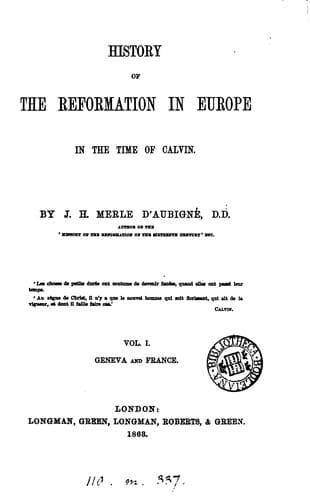
History of the Reformation in Europe in the Time of Calvin, Vol. 6 (of 8) — John Shaqi
History of the Reformation in Europe in the Time of Calvin, Vol. 6 (of 8)Merle d'Aubigné, J. H. (Jean Henri)
History
History of the Reformation in Europe in the Time of Calvin, Vol. 6 (of 8)
Merle d'Aubigné, J. H. (Jean Henri)
Reformation
were cited, but they were dismissed with the request to be satisfied
with the faith of the Church. This took place about the year 1512,
the year in which Zwingle began to search the Scriptures and in which
Luther on Pilate’s Staircase at Rome heard that word which went on
resounding in his heart, ‘The just shall live by faith.’ The brave
Scotchwoman had fought a battle at an outpost and sounded the prelude
to the Reformation.
[Sidenote: ELECTION OF A BISHOP IN SCOTLAND.]
Unhappily the accession of Henry VIII. to the throne of England turned
the thoughts of the King of Scotland in another direction. Henry
VII., as long as he lived, had striven to keep on good terms with
his son-in-law; but Henry VIII., a monarch haughty, sensitive, and
impatient, and who in mere wilfulness would quarrel with his neighbors,
was far less friendly with his sister’s husband. He even delayed for a
long time the payment of the legacy which her father had left her. The
frequent attacks of the English, and the necessity thereby imposed on
the Scots of constantly keeping watch on the borders, had given rise
to distrust and hatred between the two nations. At the same time the
ancient rivalry of France and England had thrown Scotland on the side
of the French. When the English eagle pounced on unguarded France,
‘the weasel Scot’ came sliding into its nest and devoured the royal
brood.[8] Henry VIII. revived those ancient traditions; and France
took advantage of them to enfeoff Scotland still further to herself
at the very moment when the Medici and the Guises were on the point
of seizing at Paris the reins of government. Insulted by Henry VIII.,
James IV. resolved, in spite of the wise remonstrance of the old earl
of Angus, to attack England. Scotland gave him the _élite_ of her
people. He fought at Flodden with intrepid courage, but hit by two
arrows and struck by a battle-axe he fell on the field, while round
him lay the corpses of twelve earls, thirteen lords, two bishops, two
mitred abbots, a great number of gentlemen, and more than ten thousand
soldiers. Several students, and among them one named Andrew Duncan, son
of the laird of Airdrie, whom we shall meet again, were either killed
or made prisoners on that fatal day.
Public-domain text, read in full here on John Shaqi.
Reviews
Reviews
No reviews yet
Be the first to share your thoughts on this work.
Join the Discussion
Join the discussion
Sign in to leave a comment or review.
Sign InorCreate an account