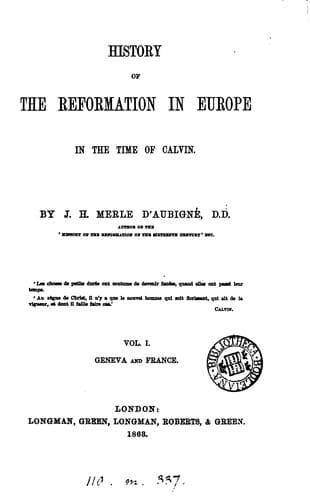
History of the Reformation in Europe in the Time of Calvin, Vol. 6 (of 8)Merle d'Aubigné, J. H. (Jean Henri)
History
History of the Reformation in Europe in the Time of Calvin, Vol. 6 (of 8)
Merle d'Aubigné, J. H. (Jean Henri)
Reformation
Among the protectors of these brave folk was John Campbell, laird of
Cessnock, a man well grounded in the evangelical doctrine, modest
even to timidity, but abounding in works of mercy, and who received
with goodwill not only the Lollards but those even whose opinions
were opposed to his own. His partner, with a character of greater
decision than his own, was a woman well versed in the Bible, and
being thoroughly acquainted with the Scriptures was safe against
intimidation. Every morning the family and the servants assembled in a
room of the mansion, and a priest, the chaplain, opened in the midst
of them a New Testament, a very rare book at that period, and read
and explained it.[5] When this family worship and the first meal were
over, the Campbells would visit the poor and the sick. At the dinner
hour they called together some of their neighbors: monks as well as
gentlefolk would come and sit at their table. One day the conversation
turning on the conventual life and the habits of the priests, Campbell
spoke on the subject with moderation but also with freedom. The
monks, exasperated, put crafty questions to him, provoked him, and
succeeded in drawing from him words which in their eyes were heretical.
Forgetting the claims of hospitality they hastened to the house of the
bishop and denounced their host and the lady of the house. Inquiry was
set on foot; the crime of heresy was proved. Campbell saw the danger
which threatened him and appealed to the king.
James IV., who had married Margaret Tudor, daughter of Henry VII.,
was then reigning in Scotland. His life had not been spotless: he was
often tormented with remorse, and in his fits of melancholy he resolved
to make up for his sins by applying himself to the administration of
justice. He had the two parties appear before him; the monks cited
decisions of the Church sufficient to condemn the prisoner. The weak
and simple-minded Campbell was somewhat embarrassed;[6] his answers
were timid and inadequate. He could talk with widows and orphans, but
he could not cope with these monks. But his wife was full of decision
and courage. When requested by the king to speak, she took up one by
one the accusations of the monks, and setting them face to face with
the Holy Scriptures, showed their falsehood. Her speech was clear,
serious, and weighty with conviction. The king, persuaded by her
eloquence, declared to the monks that if they should again persecute
honest people in that way, they should be severely punished. And then,
touched by the piety of this eminent woman and wishing to give her
a token of his respect, he rose from his seat, went up to her and
embraced her.[7] Turning to her husband, ‘As for you,’ said he, ‘I give
you in fee such and such villages, and I intend them to be testimonies
for ever of my good will towards you.’ The husband and wife withdrew
full of joy, and the monks full of vexation and shame. Thirty other
evangelicals, professing the same doctrines as the laird of Cessnock,
Public-domain text, read in full here on John Shaqi.
Reviews
Reviews
No reviews yet
Be the first to share your thoughts on this work.
Join the Discussion
Join the discussion
Sign in to leave a comment or review.
Sign InorCreate an account