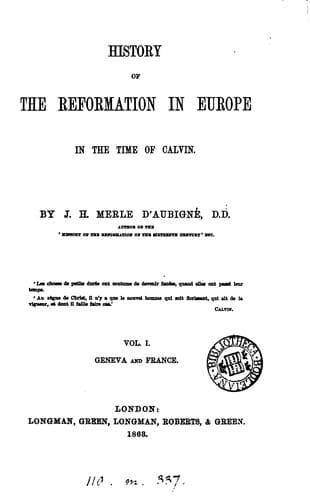
History of the Reformation in Europe in the Time of Calvin, Vol. 6 (of 8)Merle d'Aubigné, J. H. (Jean Henri)
History
History of the Reformation in Europe in the Time of Calvin, Vol. 6 (of 8)
Merle d'Aubigné, J. H. (Jean Henri)
Reformation
These important acts met with no opposition even from the citizens who
subsequently so sturdily resisted the rules of discipline. There was
however a certain show of opposition, but it was in mere sport. The
high-spirited youth of the town, easily excited, indulged in laughter
and sarcasm. They were especially annoyed at the zeal of the syndic
Porral, which crossed them in their pastimes; and when new syndics
had been elected, February 4, and Porral went out of office, these
youngsters began the next day to _play at Picca-Porral_. They wore in
the hat, as a badge, a leek (_porreau_), and served at their feasts a
dish of leeks. Each of them would prick the _porral_ with abundance
of jests. ‘Légier Beschaut and some other young men of the town’ were
imprisoned, February 5, for this sport.[462] Porral requested Farel to
accompany him to the prison, for the purpose of admonishing them. But
the young folk did not profit by it. Some have called them frolicsome,
others dissolute. We think that the former term is the most fitting.
As the council saw in the proceedings of the young culprits, says a
contemporary,[463] more of youth and foolishness than of malicious
intention, they set them at liberty four days after their arrest,
under promise to appear again when required. It is very likely that
Porral had acted with a little too much rigor in this affair.
[Sidenote: CALVIN’S REQUIREMENTS.]
The Genevese people testified their hearty acceptance of this
Christian constitution by electing, February 5, syndics devoted to
the Reformation. Other candidates of note were rejected. It was
acknowledged that the equality of the citizens was established by
this constitution, the rules applying to all alike, ‘and families of
the highest distinction being bound to submit like other people.’
This gratified the commonalty. Calvin, however, did not indulge in
illusions. He was afraid that a certain number of citizens, and even
some of the highest eminence, would oppose the Reform; and he urgently
required that all should be called upon to profess it. ‘In default
of this,’ he said, ‘he would stay no longer at Geneva.’[464] What he
had presented was for the benefit of all. If all would not accept it,
he would go away, for he had no intention of invading or usurping by
force or by fraud. On March 13, the council resolved to see to the
Lord’s Supper, and to the observance of the other articles.[465] On
April 17 it was decreed that a syndic, the captain of the quarter,
and the tithing men (_dizeniers_) should visit all the houses of the
tithings (_dizaines_) to propose the articles respecting the faith.
On the 27th of the same month it was resolved to print the confession
of faith, and to furnish a sufficient number of copies to the tithing
men for the inhabitants of their tithings, in order that when the
people should be visited they might be better instructed and well
informed.[466] Each man should know what he was going to do; there
must be no surprise.
Public-domain text, read in full here on John Shaqi.
Reviews
Reviews
No reviews yet
Be the first to share your thoughts on this work.
Elsewhere in the archive
Join the Discussion
Join the discussion
Sign in to leave a comment or review.
Sign InorCreate an account