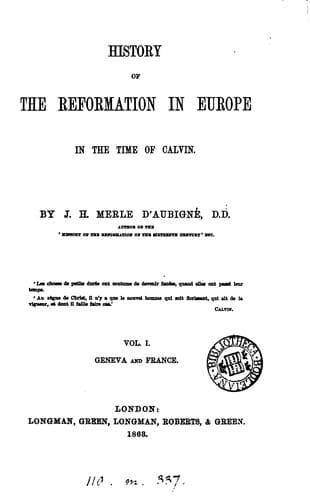
History of the Reformation in Europe in the Time of Calvin, Vol. 6 (of 8) — John Shaqi
History of the Reformation in Europe in the Time of Calvin, Vol. 6 (of 8)Merle d'Aubigné, J. H. (Jean Henri)
History
History of the Reformation in Europe in the Time of Calvin, Vol. 6 (of 8)
Merle d'Aubigné, J. H. (Jean Henri)
Reformation
To a strong dislike of the writings of the sophists Hamilton joined a
great love for those of the true philosophers. But presently a light
more pure than that of Plato and Aristotle shone in his eyes. As early
as 1520 the writings of Luther were read with eager interest by the
students of the schools of Paris; some of whom took part with, others
against the Reformation. Hamilton was listening to these disputations
and reading the books which came from Germany, when suddenly he learnt
the tragical death of Sir Patrick. He was profoundly affected by the
tidings, and began to seek God with yet more ardor than before. He
was one more example of the well-known fact, that at the very moment
when all the sorrows of the earthly life overwhelm the soul, God
gives to it the heavenly life. Two great events--the death of Sir
Patrick, and the beginning of the Reformation in Paris--occurring
simultaneously--occasioned in the soul of the young Scotchman a
collision by which a divine spark was struck out. The fire once kindled
in his heart, nothing could thenceforth extinguish it.
Hamilton took the degree of Master of Arts about the close of 1520,
as still appears in the registers of the University. He may possibly
have visited Louvain, where Erasmus then dwelt; he returned to Scotland
probably in 1522.
CHAPTER II.
THE MOVEMENT OF REFORM BEGINS.
(1522 TO APRIL 1527.)
The Reformation seems to have begun in Scotland with the profession of
those principles, Catholic but antipapal, which had been maintained a
century earlier at the Council of Constance. There were doctors present
there who set out from the thought that from the age of the Apostles
there always had been, and that there always will be, a church one and
universal, capable of remedying by its own action all abuses in its
forms of worship, dissensions among its members, the hypocrisy of its
priests, and the despotic assumptions of the first of its pontiffs.
John Mayor had been recently called to Glasgow University. Among
his audience there John Knox distinguished himself by his passion
for study; and not far from him was another young Scotchman, of a
less serious turn, Buchanan. ‘The church universal,’--so were they
taught by the disciple of d’Ailly and of Gerson--‘when assembled in
council, is above the pope, and may rebuke, judge, and even depose
him. The Roman excommunications have no force at all if they are not
conformed to justice. The ambition, the avarice, the worldly luxury
of the Roman court and of the bishops are to be sharply censured.’ On
another occasion, the professor, passing from theology to politics,
avowed doctrines far in advance of his age. He taught that a people,
in its entirety, is above the monarch; that the power of the king is
derived from the people, and that if a prince acts in opposition to
the interests of his subjects, the latter have the right to dethrone
him.
Public-domain text, read in full here on John Shaqi.
Reviews
Reviews
No reviews yet
Be the first to share your thoughts on this work.
Join the Discussion
Join the discussion
Sign in to leave a comment or review.
Sign InorCreate an account