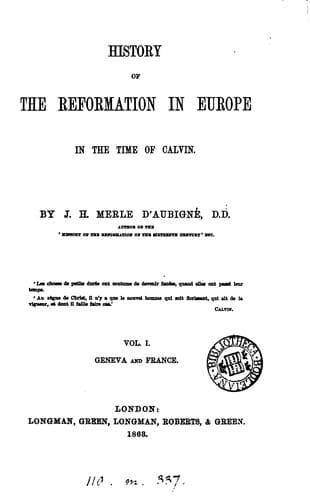
History of the Reformation in Europe in the Time of Calvin, Vol. 6 (of 8) — John Shaqi
History of the Reformation in Europe in the Time of Calvin, Vol. 6 (of 8)Merle d'Aubigné, J. H. (Jean Henri)
History
History of the Reformation in Europe in the Time of Calvin, Vol. 6 (of 8)
Merle d'Aubigné, J. H. (Jean Henri)
Reformation
Mayor went further still, even to the blameworthy extreme of
asserting that in certain cases the king might be put to death.[20]
These political principles, professed by one who occupied a Roman
Catholic chair, thoroughly scholastic and superstitious, must have
influenced the convictions of Buchanan, who afterwards, in his
dialogue _De Jure Regni apud Scotos_, professed opinions which were
energetically controverted, even by Protestants. ‘In the beginning,’
said he, ‘we created legitimate kings, and we established laws binding
equally on them and on ourselves.’[21] These political heresies of the
sixteenth century are the truths of our days. The principles of Mayor
were certainly not received without exception by Knox, but they had
probably something to do with the firmness with which he maintained
the rights of the Word of God in the presence of Mary Stuart. For the
moment, Knox, disgusted with the barren theology of his master--a
stanch scholastic on many points--forsook the wilderness of the schools
and applied himself to the quest of the living fountains of the Word of
God. In 1523 Mayor removed from Glasgow to St. Andrews.
[Sidenote: PATRICK HAMILTON AT ST. ANDREWS.]
It was to St. Andrews that Patrick Hamilton betook himself on his
return from the Continent, after a visit to the bereaved family
of Kincavil. He was admitted on June 9 of the same year into the
University of the metropolitan city, and on October 3 of the following
year he was received member of the faculty of letters. St. Andrews
had powerful attractions for him. No other university in the kingdom
had on its staff so many enlightened men; and the college of St.
Leonard’s, which he entered, was the one whose teaching had the most
liberal tendencies. The studies which he had pursued, the knowledge
which he had acquired, and the rank which he held, gave him distinction
among his fellow-disciples. Buchanan, a severe judge, looked on him
as a ‘young man of great intellect and of astonishing learning.’[22]
Hamilton held the hypocrisy of the monks in such abomination that he
never would adopt either their dress or their way of life; and although
he was abbot of Ferne he never took up his residence in his monastery.
Skilled in the musical art, he composed a chant in parts, which was
performed in the cathedral, and delighted the hearers. He did more:
he dreamed, as all reformers do at the outset of their career, of
the transformation of the Catholic Church; he resolved to seek the
imposition of hands, ‘in order,’ says Fryth, ‘that he might preach the
pure Word of God.’ Hamilton did not, to be sure, preach at that time
with the boldness and the power of a Luther or a Farel. He loved the
weak; he felt himself weak; and being full of lowly-mindedness, he was
content to impart faithfully the truth which he had received.
Public-domain text, read in full here on John Shaqi.
Reviews
Reviews
No reviews yet
Be the first to share your thoughts on this work.
Join the Discussion
Join the discussion
Sign in to leave a comment or review.
Sign InorCreate an account