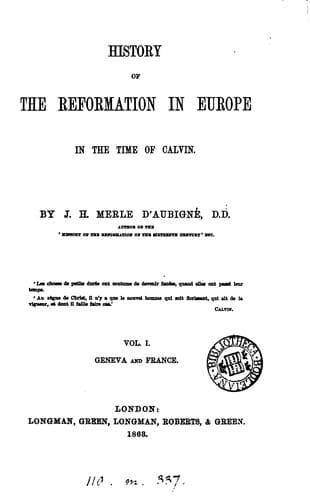
History of the Reformation in Europe in the Time of Calvin, Vol. 6 (of 8)Merle d'Aubigné, J. H. (Jean Henri)
History
History of the Reformation in Europe in the Time of Calvin, Vol. 6 (of 8)
Merle d'Aubigné, J. H. (Jean Henri)
Reformation
We almost hesitate to report his words, because they will be difficult
to comprehend. He spoke, for the faithful, of a complete union with
Christ, even with his flesh and his blood, and nevertheless of a
union which is effected only by the Spirit. Calvin’s speech was of
so much importance that we cannot think of suppressing it. Vulgar
minds insist on comprehending everything as they do the working of a
steam-engine; but the greatest minds have acknowledged the reality
of the incomprehensible. Descartes said that ‘in order to attain a
true idea of the infinite, it is not in any sense to be comprehended,
inasmuch as incomprehensibility itself is contained in the formal
definition of the infinite.’ ‘Infinity is everywhere, and consequently
incomprehensibility likewise,’ said Nicole.[533] The Christian
however comprehends to a certain extent the mystery which we are now
considering, and above all he experiences its reality. ‘If, as the
Scriptures clearly testify,’ said Calvin at the synod of Berne (1537),
‘the flesh of Christ is meat indeed, and his blood is drink indeed, it
follows that if we seek life in Christ, we must be thereby veritably
fed. The spiritual life which Christ gives us consists not only in his
making us alive by his Spirit, but in his rendering us, by the power of
his Spirit, partakers of his life-giving flesh, and by means of this
participation, nourishing us for eternal life.[534] Therefore, when we
speak of the communion which the faithful have with Christ, we teach
that they receive the communication of his body and his blood, no less
than that of his Spirit, so that they possess Christ wholly.
‘It is true that our Lord has gone up on high, and that his local
presence has thus been withdrawn from us. But this fact does not
invalidate our assertion, and that local presence is by no means
necessary here. So long as we are pilgrims on the earth, we are not
contained in the same place with him. But there is no obstacle to the
efficacy of the Spirit; he can collect and unite elements existing
in far separated places. The Spirit is the means by which we are
partakers of Christ. That Spirit nourishes us with the flesh and the
blood of the Lord, and thus quickens us for immortality. Christ offers
this communion under the symbols of bread and wine to all those who
celebrate the supper aright and in accordance with his institution.’
Such was Calvin’s speech. ‘I embrace as orthodox,’ said Bucer, ‘this
view of our excellent brothers Calvin, Farel, and Viret. I never held
that Christ was locally present in the holy supper.[535] He has a real
finite body, and that body remains in the celestial glory. But in
raising us by faith to heaven, the bread which we eat and the cup which
we drink are for us the communication of his body and his blood.’
Public-domain text, read in full here on John Shaqi.
Reviews
Reviews
No reviews yet
Be the first to share your thoughts on this work.
Elsewhere in the archive
Join the Discussion
Join the discussion
Sign in to leave a comment or review.
Sign InorCreate an account