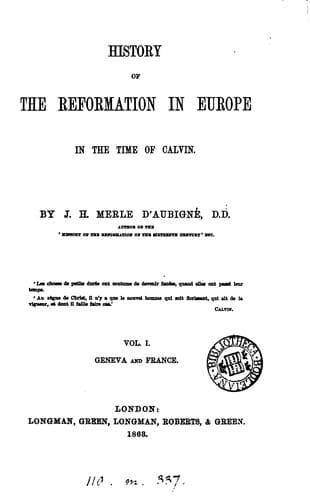
History of the Reformation in Europe in the Time of Calvin, Vol. 6 (of 8)Merle d'Aubigné, J. H. (Jean Henri)
History
History of the Reformation in Europe in the Time of Calvin, Vol. 6 (of 8)
Merle d'Aubigné, J. H. (Jean Henri)
Reformation
Calvin wrote down his view. Bucer appended to it the words last
reported. Capito signed them. Bucer even succeeded, by dint of
moderation and kindliness, in _taming_ Kunz; and the latter showed
in this instance some goodwill. ‘But,’ said Calvin at a later time,
‘that single moment was soon past, and he became worse than himself.’
The synod acknowledged the Strasburgers as justified, as faithful,
as Christians, and their confession of faith as not in any respect
contrary to the Helvetic confessions. Megander was invited to modify
his catechism to a small extent so far as it treated of the doctrine
of the supper, and this he agreed to do. The deputies of the pastors
of the canton went to the hostelry where Bucer and Capito lodged, and
requested their co-operation in putting an end to the difficulties
which existed between the ministers of the city. The council itself
exhorted these pastors to concord and peace. Such was the force of
the speech of a single man, that at the moment when the waves were in
stormiest agitation, there was suddenly a great calm.
God was in the midst of us, said one of the attendants. The divine
power had employed the speech of the reformer to appease the tumult and
establish agreement and unity.[536]
CHAPTER VII.
GENEVA.--THE CONFESSION OF FAITH SWORN AT ST. PETER’S.
(END OF 1537.)
[Sidenote: GENEVA.]
It was not only in his relations with those Christian men, Megander and
Bucer, or with the wretched Caroli, that Calvin’s efforts were crowned
with success. Happy presages seemed to announce to him a blessed and
powerful ministry at Geneva. His reformation, as we have seen, was
not only doctrinal but moral, a fact of the highest importance for
the Church and for the people. But, as happens in all human affairs,
a few spots sullied this beautiful aspect of his work. Rules were
introduced which were too circumstantial, and a mode of repression
which was too legal. Calvin found at the time a sympathy on the part of
the magistrates which was pleasant to him, but which at the same time
intruded the civil power into matters for which the moral influence of
the Church ought to have sufficed. All his requests were complied with.
He asked, together with Farel, for four preachers and two deacons, and
they were granted. He represented that there was a preacher, a good
man from Provence, who would fain retire to Geneva; and they gave him
a place.[537] One of the most violent politicians, Janin, surnamed
Colony, a great lover of novelties, after ardently embracing the
Reformation, had thrown himself with his natural impetuosity into the
notions of the _Spirituals_ or Anabaptists, and was uttering everywhere
audacious speeches on matters of faith. The council requested him
‘not to grieve the preachers,’ and added grave menaces in case he
should refuse to be corrected.[538] Another citizen, a hosier, who
Public-domain text, read in full here on John Shaqi.
Reviews
Reviews
No reviews yet
Be the first to share your thoughts on this work.
Elsewhere in the archive
Join the Discussion
Join the discussion
Sign in to leave a comment or review.
Sign InorCreate an account