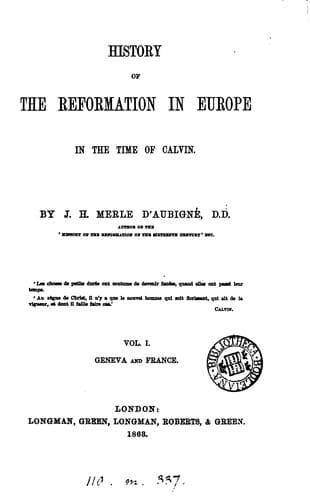
History of the Reformation in Europe in the Time of Calvin, Vol. 6 (of 8)Merle d'Aubigné, J. H. (Jean Henri)
History
History of the Reformation in Europe in the Time of Calvin, Vol. 6 (of 8)
Merle d'Aubigné, J. H. (Jean Henri)
Reformation
Ambassadors of Berne were at Geneva at the time on some question of
jurisdiction, and the opposition party endeavored to gain them over
to their cause. This was not difficult. Calvin and Farel had adhered
to the confession of Basel, which was likewise received at Berne. Now
adherence to another confession was in their eyes a violation of the
first oath. One day, at an entertainment at which the Bernese deputies
were present with the magistrates and the notabilities of Geneva, one
of the ambassadors said with a loud voice that all those who had taken
the oath to the confession of Calvin and Farel were perjured persons.
One of the leaders of the opposition, Jean Lullin, who was there, was
delighted to hear it and did not fail to publish the rash remark. It
seemed to be a giving up of the cause to the opposition, which, proud
of finding the Bernese on its side, believed its victory secured. The
people began to be restless; and many, whom the council registers
call _the mutineers_ cried out in the streets that ‘everything was to
be settled in a general council.’ These signs of resistance greatly
afflicted the reformers and, says a chronicler, ‘put Calvin about
(_pourmenait_) in a strange way.’ Within the walls of Geneva the
agitation increased. The day grew dark, and a storm appeared ready to
burst forth.[545]
[Sidenote: THE GENERAL COUNCIL.]
The council was deeply moved. Its members were accused of having
obtained their seats by illegal practices, and appeal was made to the
people. It seemed indeed as if it would be needful for the general
council to decide between them and their adversaries. The syndics
therefore, on November 23, convoked the Two Hundred to deliberate on
the matter. The latter showed themselves determined to support the
government. The magistrates in office must not think of resigning,
they said, nor attach so much importance to these clamors. ‘All this
noise is made by certain people who have no mind to amend their
ways and who want to take the place of the syndics.’ Nevertheless,
everyone perceived that it was impossible to refuse the convocation
of a general council. It was necessary, besides, to name a deputation
to Berne to treat of important business. The day fixed was Sunday,
November 25. It was agreed to prepare some fair ordinances to be read
to the assembled people. The opposition were aiming at getting rid not
only of the magistrates but of the reformers. What took place in the
council is therefore of great importance. It was the beginning of the
counter-reformation.
Public-domain text, read in full here on John Shaqi.
Reviews
Reviews
No reviews yet
Be the first to share your thoughts on this work.
Elsewhere in the archive
Join the Discussion
Join the discussion
Sign in to leave a comment or review.
Sign InorCreate an account