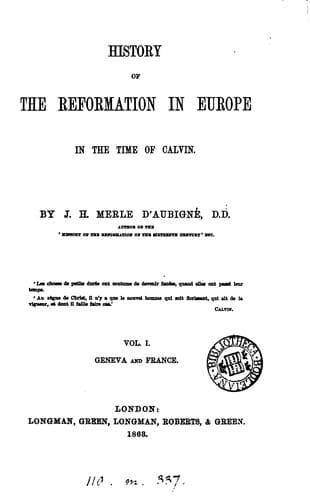
History of the Reformation in Europe in the Time of Calvin, Vol. 6 (of 8)Merle d'Aubigné, J. H. (Jean Henri)
History
History of the Reformation in Europe in the Time of Calvin, Vol. 6 (of 8)
Merle d'Aubigné, J. H. (Jean Henri)
Reformation
On the day appointed, the Two Hundred, in order to impart more
solemnity to their proceedings, assembled at the Town Hall and thence
accompanied the syndics and the council to St. Peter’s church. These
magistrates felt keenly the accusations which were spread abroad
against them by the opposition; and having a good conscience they
wished the people to decide between them and their calumniators.
Consequently, when the assembly had been formed, the following
_remonstrance_ was addressed to the people in the name of the syndics
and the councils.
‘Magnificent, discreet, most dear and honored lords,--
‘The lords syndics whom you have elected according to your custom, as
likewise their ordinary council, that of the Sixty and that of the Two
Hundred, feel hurt by the talk of some private persons, who speak as if
they had charge of the general council, alleging that the said councils
were elected by intrigues and have violated the franchises; that it
is they (the opponents) who are princes, and that they wish that for
the future everything should be transacted in a general council. The
syndics and councils desire to learn from you, gentlemen, before they
proceed further in the investigation of the matter, whether you allow
that. You know whether or not your magistrates were elected by the
intrigues of three or four citizens, as they are alleged to have been.
You know that the four syndics were chosen by you in general council;
and while in time past the ordinary council was chosen by the four
syndics, this election, since 1530, has been made by the Council of the
Two Hundred.
[Sidenote: PROCEEDINGS AT THE COUNCIL.]
‘Elected thus, the councils ask you whether you will not acknowledge
them as your magistrates, that they may continue to exercise the power
which God has given them by your general election. They are prepared
to submit to punishment with all legal rigor, if it be found that they
are in fault; but if it be otherwise, they demand that those who defame
them should suffer chastisement, so that God may not be angry with us,
nor take away the spiritual lordship and liberty which he has given us
by his Son Jesus Christ. Assuredly he has shown us more favor than he
ever did to the children of Israel. But it might happen to us as it did
to the Romans, who by civil discords of this sort lost little by little
the empire which they had acquired over the world, and fell into the
bondage in which they still remain.
‘We ought to pray God to send us well-instructed and Godfearing men to
administer justice. But if we will treat them with contempt, we shall
by-and-by find no one to serve us. Well may the heart of a citizen ache
when, after laying aside his private affairs to serve the community, he
gets for his reward the censure of those who dread correction and will
not obey the lawful authorities.
Public-domain text, read in full here on John Shaqi.
Reviews
Reviews
No reviews yet
Be the first to share your thoughts on this work.
Elsewhere in the archive
Join the Discussion
Join the discussion
Sign in to leave a comment or review.
Sign InorCreate an account