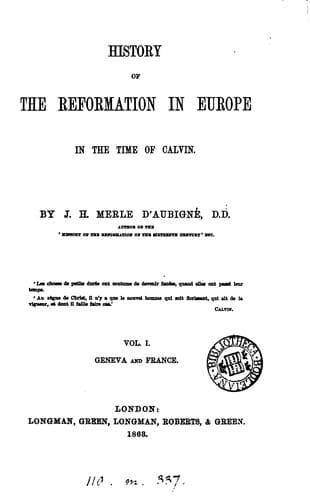
History of the Reformation in Europe in the Time of Calvin, Vol. 6 (of 8)Merle d'Aubigné, J. H. (Jean Henri)
History
History of the Reformation in Europe in the Time of Calvin, Vol. 6 (of 8)
Merle d'Aubigné, J. H. (Jean Henri)
Reformation
[Sidenote: TYNDALE’S NEW TESTAMENTS IMPORTED.]
Early in the summer, merchants of Leith, Dundee, St. Andrews, Montrose,
and Aberdeen, sent out their ships laden with the productions of
Scotland to the ports of the Netherlands, Middelburg, Antwerp, and
other towns, there to procure commodities for which there was a demand
among the Scotch. At that time there was no prohibition against the
introduction of the New Testament into Scotland: only the books of
Luther and other reformers were proscribed. These good Scottish seamen
took advantage of this; and one day Hacket, who had received orders
from Henry VIII. to burn all the Testaments translated by Tyndale
(and this ‘for the preservation of the Christian faith’), learnt at
Berg-op-Zoom, where he then was, that the Scottish traders had put on
board many copies of the Gospels as they were on the point of setting
sail for Edinburgh and St. Andrews. He started with all speed for the
ports which had been named to him: ‘I will seize those books,’ said
he, ‘even though they be already on board the ships, and I will make
a good fire of them.’[31] He got there: but alas! no more Scottish
vessels; they had sailed one day before his arrival. ‘Fortune,’ said
he, ‘did not allow me to get there in time; ah, well, have patience.’
And he gave good instructions on the matter to M. de Bever, admiral of
Flanders, and to Mr. Moffit, conservator of the Scottish nation in that
country.[32]
It was during the time that archbishop Beatoun, arch-foe of the
Reformation, was feeding his sheep on the Fifeshire hills in September,
October, and November 1526, that the New Testaments arrived and were
distributed in the towns and neighboring districts. Scotland and
England received the Holy Scriptures from the same country and almost
at the same time. The citizens of Edinburgh and the canons of St.
Andrews were reading that astonishing book as well as the citizens of
London and the canons of Oxford. There were monks who declared that it
was a bad book ‘recently invented by Martin Luther,’ but the reading of
it was not forbidden. At St. Andrews especially these sacred writings
soon shed the evangelical light over the souls of men.[33]
[Sidenote: PATRICK HAMILTON’S PREACHING.]
Public-domain text, read in full here on John Shaqi.
Reviews
Reviews
No reviews yet
Be the first to share your thoughts on this work.
Join the Discussion
Join the discussion
Sign in to leave a comment or review.
Sign InorCreate an account