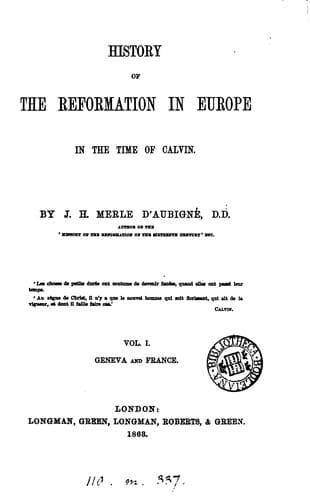
History of the Reformation in Europe in the Time of Calvin, Vol. 6 (of 8) — John Shaqi
History of the Reformation in Europe in the Time of Calvin, Vol. 6 (of 8)Merle d'Aubigné, J. H. (Jean Henri)
History
History of the Reformation in Europe in the Time of Calvin, Vol. 6 (of 8)
Merle d'Aubigné, J. H. (Jean Henri)
Reformation
The young prince, then, wearied with the yoke, threw himself, after the
tradition of his fathers, into the arms of the priests, and in order
to escape the aristocracy submitted himself to the clergy. This was a
grievous prognostic for Reform. At the end of the summer of 1526, the
queen, archbishop Beatoun, and other members of the priestly and royal
party, assembled at Stirling Castle, and a plan was there considered
and determined on which was to take away the chief power from the
nobles and give it to the bishops. John Stuart, earl of Lennox, a
friend of James V., set out from that fortress on September 4, at the
head of from ten to twelve thousand men, and marched on Edinburgh. But
Angus was already informed of what was in preparation, and Arran, who
had made his peace with him, was ready. The same day, in the morning,
the trumpet sounded in the capital, and the chief of the Douglases set
forth at the head of his army, dragging after him the young monarch.
The latter was in hope that the hour of his deliverance was come: he
advanced slowly in the rear of the army, in spite of the brutal threats
of Sir G. Douglas, his guardian. Presently the report of cannons was
heard: the king stopped. George Douglas, fancying that he would attempt
to escape, cried out, ‘Don’t think of running away, for if our enemies
had hold of you on one side and we on the other, we would pull you in
two rather than let you go.’ The King never forgot that word. Angus won
the day. Lennox had been killed by the savage James Hamilton, and the
father of the latter, when he heard it, had thrown his scarlet cloak
over the body of Lennox, exclaiming: ‘Here lies a man, the boldest,
the mightiest, and the wisest that Scotland ever possessed!’ At the
tidings of this great disaster all was confusion in Stirling Castle.
The queen fled in disguise and concealed herself: archbishop Beatoun
put off his pontifical robes, took the dress of a shepherd, and went
into retirement among the herdsmen of the Fifeshire hills, where for
nearly three months he kept a flock, no one the while suspecting that
he was the lord chancellor of the realm. Thus the anticipated triumph
of the primate and the priests, which would have been fatal to the
Reformation, was changed into a total rout, and greater religious
freedom was given to Scotland.[30]
But this was not enough. The reform of the Church by the Church itself
would not suffice; nor would reform by the writings of the reformers;
there was need of a mightier principle,--the Word of God. This Word
does not merely communicate a bare knowledge; it works a transformation
in the will and in the life of man, and as soon as such a change is
accomplished in two or three individuals in any place whatsoever, there
exists a church. The increased liberty enjoyed in Scotland after the
flight of the primate favored the introduction of this mighty Word,
to which it was reserved to effect the complete enfranchisement of the
nation.
Public-domain text, read in full here on John Shaqi.
Reviews
Reviews
No reviews yet
Be the first to share your thoughts on this work.
Join the Discussion
Join the discussion
Sign in to leave a comment or review.
Sign InorCreate an account