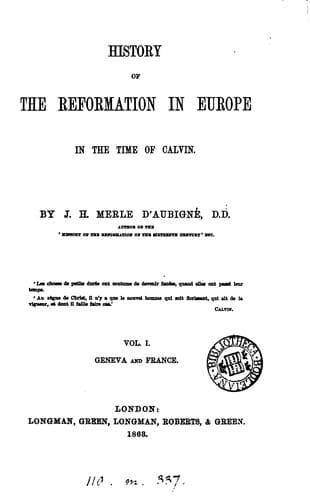
History of the Reformation in Europe in the Time of Calvin, Vol. 6 (of 8)Merle d'Aubigné, J. H. (Jean Henri)
History
History of the Reformation in Europe in the Time of Calvin, Vol. 6 (of 8)
Merle d'Aubigné, J. H. (Jean Henri)
Reformation
Thus we see that the opposition between science and faith was already
attracting attention, and the landgrave settled the question by
excluding science and those learned in it, since they were not in
agreement with the Scriptures; just as in other ages men would have
theology and theologians set aside, since they were not in agreement
with human learning. No one ought to teach in the schools of theology
except in conformity with the Scriptures of God, the supreme authority
in the Church. To disregard this principle is to take in hand to
destroy the flock of God. The fanaticism of the School, however,
cannot justify the fanaticism of the Church. It is a grave matter
to banish science on account of the dangers to which it exposes us.
To exclude the fire from the hearth for fear of conflagration would
not be reasonable; far better to take the precautions which good
sense points out for preventing the evil. If science and faith are
to advance together without peril, it can only be brought about by
the intervention of the moral principle. The existence of so-called
freethinkers arises from a moral decay; certain excesses of an
exaggerated orthodoxy may perhaps proceed from the same cause. A
presumptuous and passionate haste, affirming and denying to the first
comer, is a grave fault. How many times has it happened that some law,
some fact proclaimed by science at one period as sufficient to convict
the Scriptures of error, has had to be given up soon after by science
herself as a mistake. But let religious men be on their guard against
the indolence and the cowardice which would lead them to repulse
science, out of fear lest she should remain mistress of the field of
battle. By so doing they would deprive themselves of the weapons most
serviceable for the defence of their treasures as well as of the most
fitting occasions for spreading them abroad. Lambert did not go to such
a length; but he was persuaded that unless a breath divine, coming
from on high, give life to academical teaching, the university would
be nothing more than a dead mechanism, and that science, instead of
propagating a healthy and enlightened cultivation, would only darken
and pervert men’s minds. This is surely a very reasonable and very
practical thought, and it is to be regretted that it has not always
regulated public instruction.
Public-domain text, read in full here on John Shaqi.
Reviews
Reviews
No reviews yet
Be the first to share your thoughts on this work.
Join the Discussion
Join the discussion
Sign in to leave a comment or review.
Sign InorCreate an account