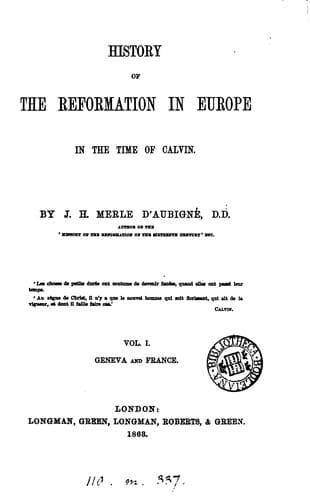
History of the Reformation in Europe in the Time of Calvin, Vol. 6 (of 8)Merle d'Aubigné, J. H. (Jean Henri)
History
History of the Reformation in Europe in the Time of Calvin, Vol. 6 (of 8)
Merle d'Aubigné, J. H. (Jean Henri)
Reformation
Will Hamilton remain at Marburg? Shall he not see Luther, Melanchthon,
and the other doctors of the Reformation? It has been generally
supposed that he did go to Wittenberg; but there is no evidence
of this, either in the University registers or in Luther’s or
Melanchthon’s letters. This tradition, therefore, appears to us to be
unfounded. As Hamilton had, however, formed the intention of visiting
Luther when he left Scotland, what motive led him to relinquish his
design? It was this. Early in July, at the very time when the young
Scotchman might have gone to Wittenberg, a report was spread abroad
that Luther had suddenly fallen ill. On July 7 he had lost the use of
his senses, his body lay motionless, the heart scarcely beating, while
his wife and his weeping friends stood round the bed, on which he was
stretched as if dead. He came to himself, however, and, persuaded that
he was at the point of death,[46] he resigned himself entirely to the
hand of God and prayed with much fervency. At the same time the report
ran in Germany that the plague was raging at Wittenberg. When Luther
had recovered a little strength, he wrote to Spalatin:--‘May the Lord
have pity on me and not forsake _his_ sinner!’[47] Soon after, he had
fresh attacks. ‘Ah,’ said he to his friends, ‘people fancy, because
joy usually brightens my countenance, that I walk on roses, but God
knows how rugged life is for me!’ One day, when Jonas had come to take
supper with him, Luther, feeling ill during the meal, suddenly rose,
and after taking a few steps fell in a fainting fit. ‘Water, water,’
cried he, ‘or I die.’ As he lay on the bed, he lifted up his eyes and
said: ‘O my beloved Lord, thou art master of life and of death, do
as it pleaseth thee. Only remember that it is thou who didst bid me
undertake this work, and that it is for thy truth, for thy Word, that I
have fought.’
On the following day, at six o’clock in the evening, as Jonas again
stood by the bedside of his friend, he heard him calling on the Lord,
sometimes in German, sometimes in Latin. The thought that he had not
done enough, nor suffered enough for his Saviour, distressed him.
‘Ah,’ said he, ‘I have not been judged worthy to shed my blood for
the love of Christ, as several of my brethren have done.’ Presently a
thought consoled him: ‘St. John the Evangelist also,’ said he, ‘had not
that honor--he who nevertheless wrote a book (Apocalypse) against the
papacy, far more severe than any that I could ever write.’[48] After
that he had his little John brought to him, and looking at the mother
of the boy, he said, ‘You have nothing; but God will provide for you.’
[Sidenote: THE PLAGUE AT WITTENBERG.]
Public-domain text, read in full here on John Shaqi.
Reviews
Reviews
No reviews yet
Be the first to share your thoughts on this work.
Join the Discussion
Join the discussion
Sign in to leave a comment or review.
Sign InorCreate an account