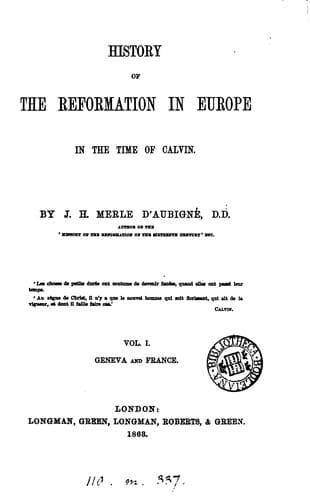
History of the Reformation in Europe in the Time of Calvin, Vol. 6 (of 8) — John Shaqi
History of the Reformation in Europe in the Time of Calvin, Vol. 6 (of 8)Merle d'Aubigné, J. H. (Jean Henri)
History
History of the Reformation in Europe in the Time of Calvin, Vol. 6 (of 8)
Merle d'Aubigné, J. H. (Jean Henri)
Reformation
The plague, as we have said, was at Wittenberg. Two persons died of it
in Melanchthon’s house; one of his sons was attacked, and one of the
sons of Jonas lost his life. Hans Luft, the printer of Marburg, who was
at Wittenberg on business, fell ill, and his mind wandered.[49] He was
removed to Marburg, where Hamilton was.
Terror became general at Wittenberg. All who could do so, and
especially the students, quitted the town; the university was
transferred to Jena. Luther pressed the elector to go thither with
his family, but, he added, in such calamities pastors must bide at
their post. He remained therefore, and Melanchthon, who was visiting
the churches in Saxony, received orders to go to Jena and resume his
lectures there. During this period Luther, having regained some little
strength, was visiting the sick and consoling the dying. In the course
of a few days he had about him eighteen dead, some of whom even expired
almost in his arms.[50] He received into his house the poor, widows,
orphans, and even the plague-stricken; his house become a hospital.[51]
His wife and his son were attacked. ‘What conflicts!’ cried he, ‘what
terrors! No matter; though the malady waste the body, the Word of
God saves the soul.’ He again fell ill himself, and thinking that he
was nigh to death, he wrote to Melanchthon: ‘Pray for me, vile and
miserable worm. I have only one glory, and that is that I have taught
purely the word of God.[52] He who has begun the work will complete it.
I seek only Him; I thirst for nothing but his grace.’
Such, doubtless, were the circumstances which detained Hamilton at
Marburg. On hearing that in consequence of the plague the courses of
lectures had partly at least been transferred to Jena, he gave up
Wittenberg; and thus is explained quite naturally the want of original
documents respecting his alleged sojourn at the Saxon university. A
very painful sacrifice was thus demanded of him. Lambert resolved
to turn the disappointment to good account. Having a high idea of
the faith, the judgment, and abilities of Hamilton, he begged him to
compose some _theses_ on the evangelical doctrine, and to defend them
publicly. Everyone supported this request; for an academical solemnity,
at which a foreign theologian belonging to the royal family of
Scotland should hold the chief place, could not fail to throw a certain
_éclat_ over the new university. Hamilton consented.[53] His subject
was quickly chosen. In his eyes a man’s religion was not sound unless
it had its source in the Word of God and in the inmost experience of
the soul which receives that Word, and is thereby led into the truth.
He deemed it necessary to present the doctrine in this practical
aspect, rather than to lose himself in the speculative theorems of an
obscure scholasticism.
Public-domain text, read in full here on John Shaqi.
Reviews
Reviews
No reviews yet
Be the first to share your thoughts on this work.
Join the Discussion
Join the discussion
Sign in to leave a comment or review.
Sign InorCreate an account