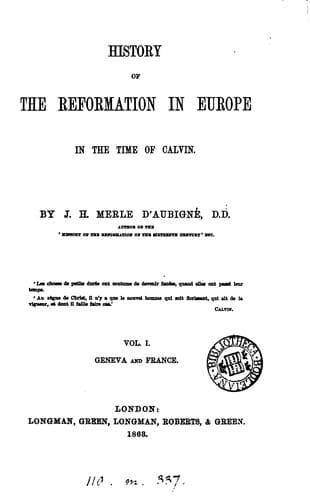
History of the Reformation in Europe in the Time of Calvin, Vol. 6 (of 8)Merle d'Aubigné, J. H. (Jean Henri)
History
History of the Reformation in Europe in the Time of Calvin, Vol. 6 (of 8)
Merle d'Aubigné, J. H. (Jean Henri)
Reformation
Already, before his return, the sacred books had arrived in large
numbers in the principal ports of the kingdom. Attention had been
awakened; but at the same time ignorance, dishonesty, and fanaticism
had risen in revolt against the Evangelical Scriptures. The priests
said that the _Old_ Testament was the only true one, and pretended
that the _New_ had been recently invented by Martin Luther.[60]
Consequently, in August 1527, the earl of Angus, at the instigation of
Dunbar, bishop of Aberdeen, had confirmed the ordinance of 1525, and
had decreed that the king’s subjects who circulated the sacred books
should be visited with the same penalties as people from abroad. If,
therefore, a vessel arrived at Leith, Dundee, St. Andrews, or Aberdeen,
the king’s officers immediately went on board, and if any copies of
the _New_ Testament were found there, the ship and the cargo were
confiscated and the captain was imprisoned.
[Sidenote: HAMILTON’S ZEAL.]
Some time after this ordinance, the ship which carried Hamilton reached
port, and although this young Christian always had his New Testament
in his pocket, he landed without being arrested and went his way to
Kincavil. It was about the end of 1527. Patrick tenderly loved his
mother and his sister; everybody appreciated his amiable character;
the servants and all his neighbors were his friends. This gentleness
made his work easier. But his strength lay above all in the depth and
the sincerity of his Christian spirit. ‘Christ bare our sins on his
back and bought us with his blood’;[61] this was the master chord which
vibrated in his soul. In setting forth any subject he silenced his own
reasonings and let the Bible speak. No one had a clearer perception
of the analogies and the contrasts which characterize the evangelical
doctrine. With these intellectual qualities were associated eminent
moral virtues; he practised the principles which he held to be true
with immovable fidelity; he taught them with a touching charity; he
defended them with energetic decision. Whether he approached a laborer,
a monk, or a noble, it was with the desire to do him good, to lead
him to God. He taxed his ingenuity to devise all means of bearing
witness to the truth.[62] His courage was firm, his perseverance
unflagging, and in his dignified seriousness his youth was forgotten.
His social position added weight to his influence. We have seen that
the aristocracy played a far larger part in Scotland than in any other
European country. It would have seemed a strange thing to the Scots
for a man of the people to meddle with such a matter as reform of the
Church; but if the man that spoke to them belonged to an illustrious
family, the position which he took appeared to them legitimate, and
they were all inclined to listen to his voice. Such was the reformer
whom God gave to Scotland.
Public-domain text, read in full here on John Shaqi.
Reviews
Reviews
No reviews yet
Be the first to share your thoughts on this work.
Join the Discussion
Join the discussion
Sign in to leave a comment or review.
Sign InorCreate an account