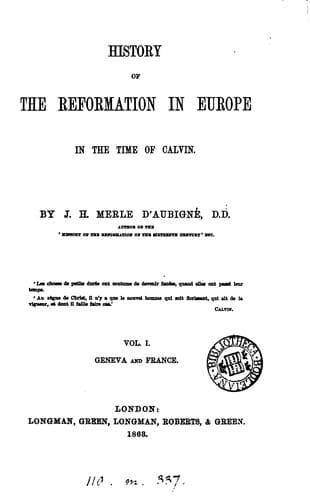
History of the Reformation in Europe in the Time of Calvin, Vol. 6 (of 8) — John Shaqi
History of the Reformation in Europe in the Time of Calvin, Vol. 6 (of 8)Merle d'Aubigné, J. H. (Jean Henri)
History
History of the Reformation in Europe in the Time of Calvin, Vol. 6 (of 8)
Merle d'Aubigné, J. H. (Jean Henri)
Reformation
In the midst of all these labors, however, Hamilton was thinking of
Scotland. It was not of the benefices which had been conferred on him,
not of St. Andrews, nor of the misty lochs or picturesque glens; it was
not even of his family, or of his friends that he thought the most.
What occupied his mind night and day was the ignorance and superstition
in which his countrymen were living. What powerfully appealed to him
was the necessity of giving glory to God and of doing good to his own
people. And yet would it not be madness to return to them? Had he not
seen the animosity of the Scottish clergy? Did he not know well the
power of the primate Beatoun? Had he not, only six or seven months
before, left his country in all haste? Why then these thoughts of
returning? There was good reason for them. Hamilton had been fortified
in spirit during his sojourn at Marburg; his faith and his courage had
increased; by living with decided Christians, who were ready to give
their lives for the Gospel, he had been tempered like steel and had
become stronger. It could not be doubted that extreme peril awaited
him in Scotland; his two friends, John Hamilton and Wynram, did not
understand his impatience and were resolved to wait. But neither their
example nor the urgency of Lambert could quench the ardor of the young
hero. He felt the sorrow of parting with Lambert and of finally giving
up the hope of seeing Luther and Melanchthon; but he had heard God’s
call; his one duty was to answer to it. About the end of autumn 1527
he embarked with his faithful servant and sailed towards the shores of
Caledonia.
CHAPTER IV.
EVANGELIZATION, TRIBULATIONS, AND SUCCESS OF HAMILTON IN SCOTLAND.
(END OF 1527 TO THE END OF FEBRUARY 1528.)
The Church of Rome, in the sixteenth century, especially in Scotland,
was far from being apostolic, although it assumed that title: nothing
was less like St. John or St. Peter than its primates and its prelates,
worldlings and sometimes warriors as they were. The real successors
of the apostles were those reformers, who taught the doctrines of the
apostles, labored as they did, and like them were persecuted and put
to death. The theocratic and political elements combined in Rome have,
with certain exceptions, substituted the law, that is, outward worship,
ceremonial ordinances, pilgrimages and the exercises of ascetic
life for the Gospel. The Reformation was a powerful reaction of the
evangelical and moral element against the legal, sacerdotal, ascetic
and ritualistic elements which had invaded the Church. This reaction
was about to display its energy in Scotland, and Hamilton was to be at
first its principal organ.
Public-domain text, read in full here on John Shaqi.
Reviews
Reviews
No reviews yet
Be the first to share your thoughts on this work.
Join the Discussion
Join the discussion
Sign in to leave a comment or review.
Sign InorCreate an account