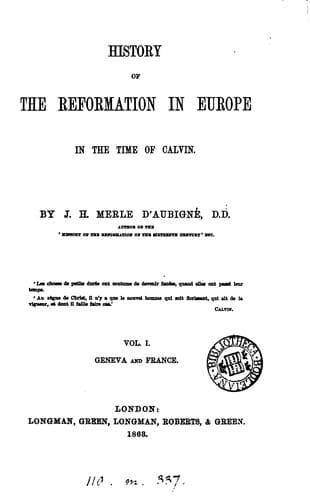
History of the Reformation in Europe in the Time of Calvin, Vol. 6 (of 8)Merle d'Aubigné, J. H. (Jean Henri)
History
History of the Reformation in Europe in the Time of Calvin, Vol. 6 (of 8)
Merle d'Aubigné, J. H. (Jean Henri)
Reformation
One day another speaker came to Hamilton. This was a young
ecclesiastic, Alexander Campbell, prior of the Dominicans, who
like Alesius had a fine genius, great learning,[83] and a kindly
disposition.[84] The archbishop, who knew his superiority, begged
him to visit Hamilton frequently, and to spare no efforts to win him
back to the Roman doctrine. Campbell obeyed his chief; but while
certain priests or monks craftily questioned the young doctor with
the intention of destroying him, the prior of the Dominicans had it
in mind to save him. It is a mistake to attribute to him from the
first any other intention. Campbell, like Alesius, was open to the
truth, but the love of the world and its favors prevailed in him, and
therein lay his danger. He frequently conversed with Hamilton on the
true sense of the Scriptures, and acknowledged the truth of Patrick’s
words. ‘Yes,’ said the prior, ‘the Church is in need of reformation
in many ways.’[85] Hamilton, pleased with this admission, hoped to
bring him to the faith, like Alesius, and having no fear of a friend
whom he already looked on almost as a brother, he kept back none of his
thoughts, and attached himself to him with all sincerity. But after
several interviews, Campbell received orders from the archbishop to
go to him to give an account of the result of his proceedings. This
request astonished and disturbed the prior; and when he stood before
Beatoun and his councillors, he was intimidated, overpowered by fear at
the thought of offending the primate, and of incurring the censures of
the Church. He would fain have obeyed at the same time both the Lord
and the bishop,--he would fain have served God and _sucked-in_ honors;
but he saw no means of reconciling the Gospel and the world. When he
saw all looks turned on him he was agitated, he wavered, and told
everything which the young noble of Kincavil had said to him in the
freedom of brotherly confidence. He appeared to condemn him, and even
consented to become one of his judges. Choosing ease, reputation, and
life rather than persecution, opprobrium, and death, Campbell turned
his back on the truth and abandoned Hamilton.
When the young reformer heard of Campbell’s treachery, it was a great
sorrow to him; but he was not disheartened. On the contrary, he went
on teaching with redoubled zeal, both at his own lodging and in the
university. He bore witness, ‘with hand and with foot,’ as used to be
said at that time (that is to say, with all his heart and with all
his might), to the Word of God. For making a beginning of the work of
reformation there was no place in the kingdom more important than St.
Andrews. Hamilton found there students and professors, priests, monks
of the orders of St. Augustine, St. Francis, and St. Dominic, canons,
deans, members of the ecclesiastical courts, nobles, jurisconsults,
and laymen of all classes. This was the wide and apparently favorable
field on which for one month he scattered plentifully the divine
seed.[86]
Public-domain text, read in full here on John Shaqi.
Reviews
Reviews
No reviews yet
Be the first to share your thoughts on this work.
Join the Discussion
Join the discussion
Sign in to leave a comment or review.
Sign InorCreate an account