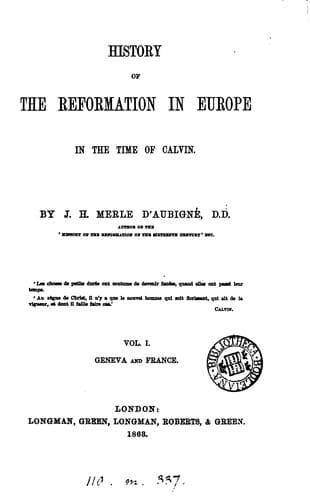
History of the Reformation in Europe in the Time of Calvin, Vol. 6 (of 8)Merle d'Aubigné, J. H. (Jean Henri)
History
History of the Reformation in Europe in the Time of Calvin, Vol. 6 (of 8)
Merle d'Aubigné, J. H. (Jean Henri)
Reformation
The adversaries of the New Testament, when they saw the success of
Hamilton’s teachings, grew more and more alarmed every day. There
must be no more delay, they thought; all compliance must cease, and
the great blow must be struck. Patrick was cited to appear at the
archiepiscopal palace, to make answer to a charge of heresy brought
against him. His friends in alarm conjured him to fly: it seemed that
even the archbishop would have been glad to see him set out once more
for Germany. Lord Hamilton, earl of Arran, was at once Patrick’s uncle
and the primate’s nephew by marriage. The primate would naturally show
some consideration for a young man whose family he respected;[87] but
the obstacle was to be raised on the part of Hamilton himself. When
he crossed the North Sea to return to Scotland, he had resolved to
lay down his life, if need be, if only by his death _Christ should be
magnified_. The joy of a good conscience was so firmly established in
his soul that no bodily suffering could take it away.
As Patrick was not minded to fly from the scaffold, his enemies
determined to rid themselves of so formidable an antagonist.
One obstacle, however, lay in their way. Would the king, feeble and
thoughtless, but still humane and generous, permit them to sacrifice
this young member of his family, who excited the admiration even of his
adversaries? James V. felt really interested in Patrick: he wished to
see him, and had urged him to be reconciled with the bishops.[88] If
at the last moment the Hamiltons should entreat his pardon, how could
he refuse it? To evade this difficulty, the Roman clergy resolved to
get the young monarch removed out of the way. His father, James IV.,
used to make a yearly pilgrimage to the chapel of St. Duthac, founded
by James III., in Ross-shire, in the north of Scotland. The bishops
determined to persuade this prince, then only seventeen, to undertake
this long journey although it was then the depth of winter.[89] The
king consented, either because he was artfully misled by the priests,
or because, seeing that they were determined to get rid of Hamilton, he
would rather let them alone, and wash his hands of it. He set out for
St. Duthac,[90] and the priests immediately applied themselves to their
task.
[Sidenote: HAMILTON’S DEATH RESOLVED ON.]
Public-domain text, read in full here on John Shaqi.
Reviews
Reviews
No reviews yet
Be the first to share your thoughts on this work.
Join the Discussion
Join the discussion
Sign in to leave a comment or review.
Sign InorCreate an account