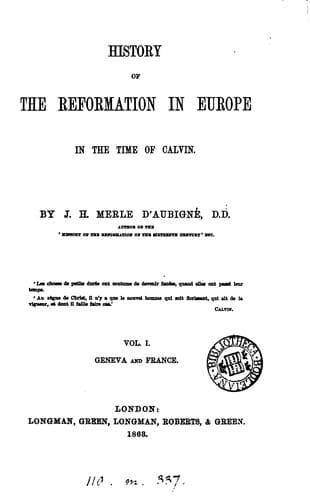
History of the Reformation in Europe in the Time of Calvin, Vol. 6 (of 8) — John Shaqi
History of the Reformation in Europe in the Time of Calvin, Vol. 6 (of 8)Merle d'Aubigné, J. H. (Jean Henri)
History
History of the Reformation in Europe in the Time of Calvin, Vol. 6 (of 8)
Merle d'Aubigné, J. H. (Jean Henri)
Reformation
While the priests were making ready to put to death one of the members
of the illustrious family of the Hamiltons, some noble-hearted laymen
were preparing to rescue him. The men of Linlithgow were not the only
ones to stir in the matter. John Andrew Duncan, laird of Airdrie, who,
as we have seen, was taken prisoner by the English at the battle of
Flodden, had, during his captivity, found friends in England, whom he
gained for the Gospel. On his return to Scotland, he had opened his
house as an asylum for the gospellers, and had become intimate with
the Hamiltons. Hearing of the danger that beset Patrick, indignant
at the conduct of the bishops and burning with desire to save the
young reformer, Duncan had armed his tenants and his servants, and
then marching towards the metropolitan city, intended to enter it by
night, to carry off his friend and conduct him to England. But the
archbishop’s horsemen, warned of the enterprise, set out and surrounded
Duncan’s feeble troop, disarmed them and made Duncan prisoner. The life
of this noble evangelical Christian was spared at the intercession of
his brother-in-law, who was in command of the forces which captured
him, but he had once more to quit Scotland.[97]
This attempt had been frustrated just at the moment when the
commissioners presented their report on the alleged heresies of
Hamilton. There was no longer any need for hesitation on the part
of the archbishop; he therefore ordered the arrest of the young
evangelist. Wishing to prevent any resistance, the governor of the
castle of St. Andrews, who was to carry out the order, waited till
night; and then putting himself at the head of a well-armed body of
men, he silently surrounded the house in which Hamilton dwelt.[98]
According to one historian, he had already retired to rest; according
to others, he was in the society of pious and devoted friends and was
conversing with them. The young reformer, while he appreciated the
affection and the eagerness of his friend Duncan, had no wish that
force should be employed to save him. He knew that of whatever nature
the war is, such must the weapons be; that for a spiritual war the
weapons must be spiritual; that Christ’s soldiers must fight only with
the sword of the holy Word. He remained calm in the conviction that God
disposes all that befalls his children in such wise that what the world
thinks an evil turns out for good to them. At the very moment when
the soldiers were surrounding his house, he felt himself encompassed
with solid ramparts, knowing that God marshals his forces around his
people, as if for the defence of a fortress. At that moment there were
knocks at the door: it was the governor of the castle. Hamilton knew
what it meant. He rose, went forward accompanied by his friends, and
opening the door asked the governor whom he wanted;[99] the latter
having answered, Hamilton said, ‘It is I!’ and gave himself up. Then
pointing to his friends he added, ‘You will allow them to retire;’[100]
Public-domain text, read in full here on John Shaqi.
Reviews
Reviews
No reviews yet
Be the first to share your thoughts on this work.
Join the Discussion
Join the discussion
Sign in to leave a comment or review.
Sign InorCreate an account