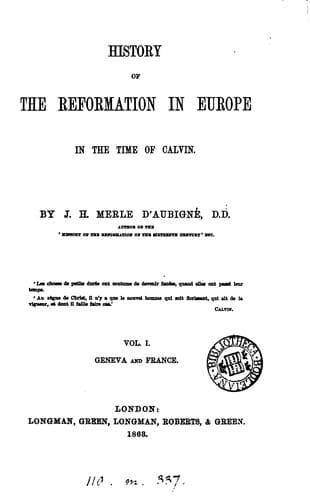
History of the Reformation in Europe in the Time of Calvin, Vol. 6 (of 8)Merle d'Aubigné, J. H. (Jean Henri)
History
History of the Reformation in Europe in the Time of Calvin, Vol. 6 (of 8)
Merle d'Aubigné, J. H. (Jean Henri)
Reformation
and he entreated them not to make any resistance to lawful authority.
But these ardent Christians could not bear the thought of losing their
friend. ‘Promise us,’ they said to the governor, ‘promise us to bring
him back safe and sound.’ The officer only replied by taking away his
prisoner. On the summit of huge rocks which rise perpendicularly from
the sea, and whose base is ceaselessly washed by the waves, stood at
that time the castle whose picturesque remains serve still as a beacon
to the mariner. It was within the walls of this feudal stronghold that
Hamilton was taken and confined.
[Sidenote: HAMILTON IN THE CASTLE.]
The last day of February at length arrived, the day fixed by the
archbishop for the solemn assembly at which sentence was to be
pronounced. The prelate, followed by a large number of bishops, abbots,
doctors, heads of religious orders, and the twelve commissioners,
entered the cathedral--a building some centuries old, which was to
be cast down in a day by a word of Knox, and whose magnificent ruins
still astonish the traveller.[101] Beatoun sat on the bench of the
inquisitorial court, and all the ecclesiastical judges took their
places round him. Among these was observed Patrick Hepburn, prior of
St. Andrews, son of the earl of Bothwell, a worthless and dissolute
man, who had eleven illegitimate children, and who gloried in bringing
distress and dishonor into families. This veteran of immorality--who
ought to have been on the culprit’s seat, but whose pride was greater
even than his licentiousness--took his place with a shameless
countenance on the judges’ bench. Not far from him was David Beatoun,
abbot of Arbroath, an ambitious young man, who was already coveting
his uncle’s dignity, and who, as if to prepare himself for a long work
of persecution, vigorously pressed on the condemnation of Patrick.
In the midst of these hypocrites and fanatics sat one man in a state
of agitation and distress--the prior of the Dominicans, Alexander
Campbell--with his countenance gloomy and fallen. A great crowd of
canons, priests, monks, nobles, citizens, and the common people, filled
the church; some of them greedy for the spectacle which was to be
presented to them, others sympathizing with Hamilton. ‘I was myself
present,’ said Alesius, ‘a spectator of that tragedy.’[102]
Public-domain text, read in full here on John Shaqi.
Reviews
Reviews
No reviews yet
Be the first to share your thoughts on this work.
Join the Discussion
Join the discussion
Sign in to leave a comment or review.
Sign InorCreate an account