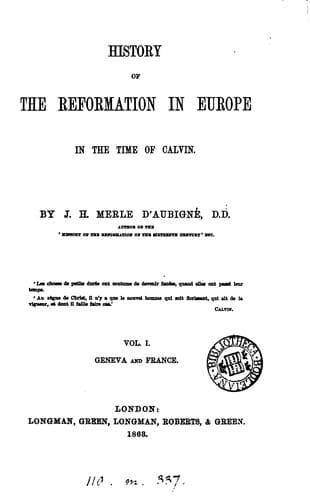
History of the Reformation in Europe in the Time of Calvin, Vol. 8 (of 8)Merle d'Aubigné, J. H. (Jean Henri)
History
History of the Reformation in Europe in the Time of Calvin, Vol. 8 (of 8)
Merle d'Aubigné, J. H. (Jean Henri)
Reformation
Two parties therefore existed in England, and these frequently
concerned themselves more with the points on which they differed than
with the great facts of their religion. In one pulpit a preacher would
call for reformation of the abuses of Rome; in a neighboring church,
another preacher would advocate their maintenance at any cost. One
monk of York preached against purgatory, while some of his colleagues
defended the doctrine. All this gave rise to most exciting discussion
amongst the hearers. In addition to the two chief parties, there were
the profane, animated by a spirit of unbelief and without reverence
for sacred things. While pious men were peacefully assembled for the
reading of the Holy Scriptures, these mockers sat in public-houses
over their pots of beer, uttering their sarcasms against every body,
and especially against the priests. If they spoke of those who gave
only the wafer, and not the wine, they would say:--'That is because
he has drunk the whole of it; the bottle is empty.' At times they
undertook even to discuss, as in old times was done at Byzantium,
the most difficult points in theology, and this was still worse. The
king, anxious to play his part as head of the church, was desirous of
bringing about a union of the two chief parties, and had no doubt that
the party of the profane would then disappear. His favorite notion,
like that of princes in general, was to have but one single religious
opinion in his kingdom. Freedom was a restraint to him. He therefore
began, as the emperor Constantine had done, by attempting to gain his
end by means of a system of indifference and of subjection to his will.
In a royal proclamation he required that the party of reformation and
the party of tradition should 'draw in one yoke,'[284] like a pair of
good oxen at the plough. He did not omit, however, to read the priests
a lesson. He rebuked them for busying themselves far more with the
distribution of the consecrated wafer and with the sprinkling of their
flocks with holy water than with teaching them what these acts meant.
Indifference, however, was of course unattainable, for it implies that
each party should consider unimportant the very doctrines on which it
sets the highest value. Henry, nevertheless, boldly made the attempt.
Public-domain text, read in full here on John Shaqi.
Reviews
Reviews
No reviews yet
Be the first to share your thoughts on this work.
Elsewhere in the archive
Join the Discussion
Join the discussion
Sign in to leave a comment or review.
Sign InorCreate an account