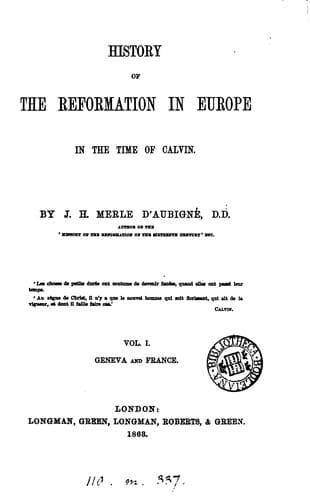
History of the Reformation in Europe in the Time of Calvin, Vol. 8 (of 8)Merle d'Aubigné, J. H. (Jean Henri)
History
History of the Reformation in Europe in the Time of Calvin, Vol. 8 (of 8)
Merle d'Aubigné, J. H. (Jean Henri)
Reformation
When the parliament met on April 28, 1539, the lord chancellor
announced that the king was very anxious to see all his subjects
holding one and the same opinion in religion, and required that a
committee should be nominated to examine the various opinions, and
to draw up articles of agreement to which every one might give his
consent. On May 5 nine commissioners were named, five of whom were
Anglo-Catholics, and at their head was Lee, archbishop of York. A
project was presented 'for extirpating heresies among the people.' A
catalogue of heresies was to be drawn up and read at all the services.
The commissioners held discussion for one day, but neither of the two
parties would make any concession. As the vicegerent Cromwell and the
archbishop of Canterbury were in the ranks of the reformation party,
the majority was unable to gain the ascendency, and the commission
arrived at no decision.
The king was very much dissatisfied with this result. He had been
willing to leave the work of conciliation in the hands of the bishops,
and now the bishops did not agree. His patience, of which he had no
large stock, was exhausted. The Anglo-Catholic party took advantage of
his dissatisfaction, and hinted to him that if he really aimed at unity
he would have to take the matter into his own hands, and settle the
doctrine to which all must assent. Why should he allow his subjects the
liberty of thinking for themselves? Was he not in England master and
ruler of every thing?
[Sidenote: THE SIX ARTICLES.]
Another circumstance, of an entirely different kind, acted powerfully,
about this time, upon the king's mind. The pope had just entered into
an alliance with the emperor and the king of France. A fact of such
importance could not fail to make a great noise in England. 'Methinks,'
said one of the foreign diplomatists now in England, 'that if the pope
sent an interdict and excommunications, with an injunction that no
merchant should trade in any way with the English, the nation would,
without further trouble, bestir itself and compel the king to return
to the church.'[285] Henry, in alarm, adopted two measures of defence
against this triple alliance. He gave orders for the fortification of
the ports, examination of the condition of various landing-places, and
reviewing of the troops; and at the same time, instead of endeavoring
after a union of the two parties, he determined to throw himself
entirely on the Scholastic and Catholic side. He hoped thereby to
satisfy the majority of his subjects, who still adhered to the Roman
church, and perhaps also to appease the powers. 'The king is determined
on grounds of policy,' it was said, 'that these articles should
pass.'[286]
Public-domain text, read in full here on John Shaqi.
Reviews
Reviews
No reviews yet
Be the first to share your thoughts on this work.
Elsewhere in the archive
Join the Discussion
Join the discussion
Sign in to leave a comment or review.
Sign InorCreate an account