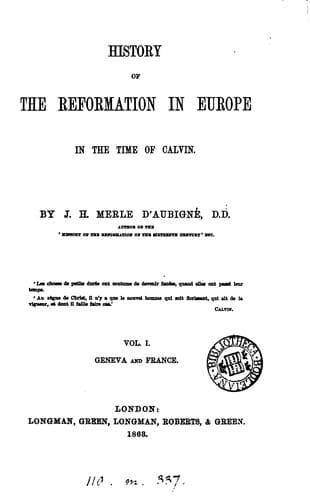
History of the Reformation in Europe in the Time of Calvin, Vol. 8 (of 8)Merle d'Aubigné, J. H. (Jean Henri)
History
History of the Reformation in Europe in the Time of Calvin, Vol. 8 (of 8)
Merle d'Aubigné, J. H. (Jean Henri)
Reformation
Six articles were therefore drawn up of a reactionary character, and
the duke of Norfolk was selected to bring them forward. He did not
pride himself on scriptural knowledge. 'I have never read the Holy
Scriptures and I never will read them,' he said; 'all that I want is
that every thing should be as it was of old.' But if Norfolk were not
a great theologian, he was the most powerful and the most Catholic
lord of the Privy Council and of the kingdom. On the 16th of May the
duke rose in the upper house and spoke to the following effect:--'The
commission which you had named has done nothing, and this we had
clearly foreseen. We come, therefore, to present to you six articles,
which, after your examination and approval, are to become binding.
They are the following: 1st, if any one allege that after consecration
there remains any other substance in the sacrament of the altar than
the natural body of Christ conceived of the Virgin Mary, he shall be
adjudged a heretic and suffer death by burning, and shall forfeit to
the king all his lands and goods, as in the case of high treason; 2d,
if any one teach that the sacrament is to be given to laymen under both
kinds; or 3d, that any man who has taken holy orders may nevertheless
marry; 4th, that man or woman who has vowed chastity may marry; 5th,
that private masses are not lawful and should not be used; or 6th,
that auricular confession is not according to the law of God, any such
person shall be adjudged to suffer death, and forfeit lands and goods
as a felon.'[287]
Cromwell had been obliged to sanction, and perhaps even to prepare,
this document. When once the king energetically announced his will
the minister bowed his head, knowing well that if he raised it in
opposition he would certainly lose it. Nevertheless, that he might
to some extent be justified in his own sight, he had resolved that
the weapon should be two-edged, and had added an article purporting
that any priest giving himself up to uncleanness should for the first
offence be deprived of his benefices, his goods, and his liberty, and
for the second should be _punished with death_ like the others.
[Sidenote: CRANMER'S OPPOSITION.]
Public-domain text, read in full here on John Shaqi.
Reviews
Reviews
No reviews yet
Be the first to share your thoughts on this work.
Elsewhere in the archive
Join the Discussion
Join the discussion
Sign in to leave a comment or review.
Sign InorCreate an account