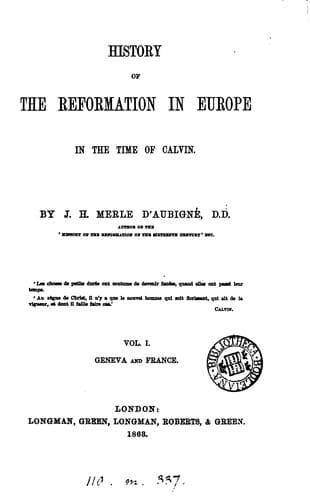
History of the Reformation in Europe in the Time of Calvin, Vol. 8 (of 8)Merle d'Aubigné, J. H. (Jean Henri)
History
History of the Reformation in Europe in the Time of Calvin, Vol. 8 (of 8)
Merle d'Aubigné, J. H. (Jean Henri)
Reformation
These articles, which have been called _the whip with six strings_
and _the bloody statute_,[288] were submitted to the parliament. But
none of the lords temporal, or of the commons, aware that the king
was fully resolved, ventured to assail them. One man, however, rose,
and this was Cranmer. 'Like a constant patron of God's cause,' says
the chronicler, 'he took upon him the earnest defence of the truth
oppressed in the parliament; three days together disputing against
those six wicked articles; bringing forth such allegations and
authorities as might easily have helped the cause, _nisi pars major
vicisset, ut sæpe olet, meliorem_.'[289] Cranmer spoke temperately,
with respect for the sovereign, but also with fidelity and courage.
'It is not my own cause that I defend,' he said, 'it is that of God
Almighty.'
The archbishop of Canterbury was not, however, alone. The bishops who
belonged to the evangelical party, those of Worcester, Rochester, St.
David's, Ely, and Salisbury, likewise spoke against the articles.[290]
But the king insisted, and the act passed. These articles, said
Cranmer at a later time, were 'in some things so enforced by the evil
counsel of certain papists against the truth and common judgment
both of divines and lawyers, that if the king's Majesty himself
had not come personally into the parliament house, those laws had
never passed.'[291] Cranmer never signed nor consented to the Six
Articles.[292]
The parliament at the same time conferred on the king unlimited powers.
A bill was carried purporting that some having by their disobedience
shown that they did not well understand what a king can do by virtue of
his royal power, it was decreed that every proclamation of his majesty,
even when inflicting fines and penalties, should have the same force as
an act of parliament. Truth had already been sacrificed, and liberty
was to be the next victim.
Public-domain text, read in full here on John Shaqi.
Reviews
Reviews
No reviews yet
Be the first to share your thoughts on this work.
Elsewhere in the archive
Join the Discussion
Join the discussion
Sign in to leave a comment or review.
Sign InorCreate an account