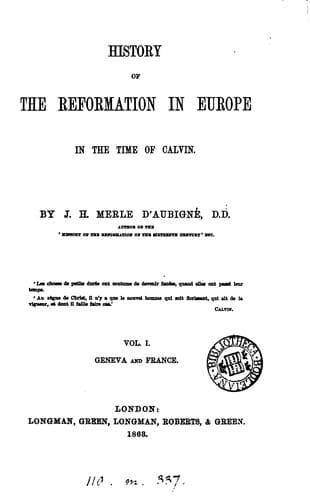
History of the Reformation in Europe in the Time of Calvin, Vol. 8 (of 8) — John Shaqi
History of the Reformation in Europe in the Time of Calvin, Vol. 8 (of 8)Merle d'Aubigné, J. H. (Jean Henri)
History
History of the Reformation in Europe in the Time of Calvin, Vol. 8 (of 8)
Merle d'Aubigné, J. H. (Jean Henri)
Reformation
Jesus Christ and his love was indeed the strength of his eloquence.
It was by setting before sinners a dying Jesus that he called them to
repentance. 'We, Lord,' he cried, 'have transgressed, and thou bearest
the punishment! Our crimes have loaded thee with all kinds of shame,
and have caused thee to die upon the cross! Oh! what sinner would not
at this sight lament over his sins!'[14] But D'Avila pointed out at
the same time in this death a means of salvation. 'They bind him with
cords,' he said; 'they buffet him; they crown him with thorns; they
nail him on the cross, and he suffers death thereon. If he is thus
treated it is because he loved you, and would wash away your sins in
his own blood! O Jesus, my Saviour, thou wast not content with these
outward sufferings; it has pleased thee to endure also inward pain
far surpassing them. Thou hast submitted to the stern decree of thy
Father's justice; thou hast taken upon thee all the sins of the world.
O Lamb of God, thou hast borne the burden alone; thou hast sufficed
thereto, and hast obtained for us redemption by thy death. We have been
made the righteousness of God in thee, and the Father loves us in his
well-beloved Son. Let us not be afraid of praising him too much for
the entire blotting out of our sins, the privilege bestowed by God on
those whom he justifies by the merits of Jesus Christ. This exalts the
greatness of those merits which have procured them so much blessedness,
although they were so unworthy of it. O Lord, be glorified forever for
this.'[15]
Nevertheless, John d'Avila, while he recognized the necessity of
justification by the death of Christ, had a less distinct conception
of it than the reformers, and gave it a less prominent place in his
teaching than they did. It was on its efficacy for sanctification
that he especially dwelt. He committed indeed the error of placing
love in the chapter of justification, instead of placing it, like
the reformers, in that of sanctification, which is its true place.
But he could not too much insist on the transformation which must
be wrought in the character and life of the Christian. 'What,' he
cried, 'is it conceivable that Jesus Christ should wash, purify, and
sanctify our souls with his own blood, and that they should still
remain unrighteous, defiled, impure?' ... He sometimes employed strange
figures to inculcate the necessity of this work. 'A creature having but
the head of a man,' he said, 'all the rest of its body being that of
a beast, would be considered a horrible monster. It would be no less
monstrous, in the sphere of grace, that God who is righteousness and
purity itself should have for his members unrighteous, defiled, and
corrupt men.'[16]
Public-domain text, read in full here on John Shaqi.
Reviews
Reviews
No reviews yet
Be the first to share your thoughts on this work.
Join the Discussion
Join the discussion
Sign in to leave a comment or review.
Sign InorCreate an account