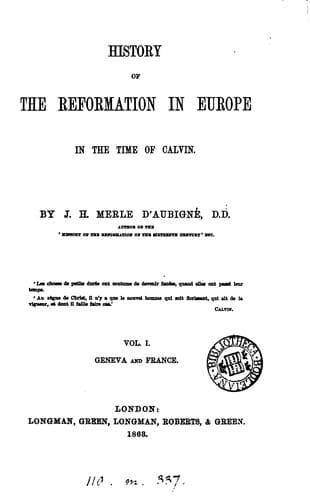
History of the Reformation in Europe in the Time of Calvin, Vol. 8 (of 8)Merle d'Aubigné, J. H. (Jean Henri)
History
History of the Reformation in Europe in the Time of Calvin, Vol. 8 (of 8)
Merle d'Aubigné, J. H. (Jean Henri)
Reformation
D'Avila labored not only by his discourses, but likewise by his
conversations and letters in promoting the kingdom of God in the
souls of men. He was benevolence itself. He consoled the afflicted,
encouraged the timid, aroused the cowardly, stirred up the lukewarm,
fortified the weak, sustained those who were tempted, sought to raise
up sinners after their falls, and humbled the proud. His letters
are mostly far superior to those of Fénélon. They are at least much
more evangelical.[17] 'I tell you this,' he wrote to some friends in
affliction, 'only in order to assure you that Jesus Christ loves you.
Ought not these words, that _a God loves us_, to fill with joy such
poor creatures as we are?'[18] 'Read the sacred writings,' said he
in another letter to those who wished for instruction, 'but remember
that if he who has the key of knowledge, and who alone can open the
book, does not give the power to comprehend, you will never understand
it.'[19]
[Sidenote: ST. THERESA.]
D'Avila possessed the gift of discernment. He did not, indeed, entirely
escape the influence of the period and of the country in which he
lived; but we find him exposing the pretended revelations of Madeline
de la Croix, who deceived so many, and undertaking the defence of the
pious Theresa de Cepedre, when persecuted by the Inquisition. Theresa,
born at Avila in 1515, of a noble family, had so much zeal even in her
childhood that she one day quitted her father's house with her brother
to go and seek martyrdom amongst the Moors. A relative met the two
children and took them back. She was from that time divided between the
love of the world and the love of God, throwing herself alternately
into dissipation and into the monastic life. This woman, the famous St.
Theresa, was one of those ardent spirits who rush by turns to the two
extremes. Happily she met with D'Avila, whose judgment was more mature
than her own, received his instructions, and, by his means, became
confirmed in spiritual life. Her writings, full of piety, and even
attractive in style, were translated by the Jansenists, like those of
D'Avila.[20] He was the friend and director to a poor soldier, who,
having been discharged in 1536, was converted, and turned his house
into an hospital, for which he provided by the work of his own hands,
and thus became founder of the Order of Charity. D'Avila gave to this
charitable Christian, who was called John de Dieu, the wisest counsels,
the sum of which was, 'Die rather than be unfaithful to so good a
Master.'
Public-domain text, read in full here on John Shaqi.
Reviews
Reviews
No reviews yet
Be the first to share your thoughts on this work.
Join the Discussion
Join the discussion
Sign in to leave a comment or review.
Sign InorCreate an account