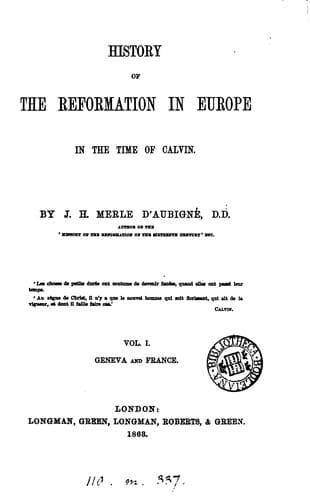
History of the Reformation in Europe in the Time of Calvin, Vol. 8 (of 8)Merle d'Aubigné, J. H. (Jean Henri)
History
History of the Reformation in Europe in the Time of Calvin, Vol. 8 (of 8)
Merle d'Aubigné, J. H. (Jean Henri)
Reformation
The cities of Lower Saxony were the first to be touched by the light
which proceeded from electoral Saxony. Magdeburg, where Luther had been
at school and had personal friends, had early shown itself friendly to
evangelical principles. One day, an old clothier came and stood at the
foot of the monument erected in this town to the illustrious Emperor
Otto the Great, in memory of his conquests in the tenth century; and
the zealous partisan of the spiritual conqueror of the sixteenth
century began to sing one of Luther's hymns and to sell copies of it.
People were at the time coming out of a neighboring church, where mass
had been said. Many had received the leaf, but the burgomaster who
was passing with others of the faithful had the seller arrested. This
caused the fire which was smouldering under the embers to flame forth.
The parishioners of St. Ulrich assembled in the cemetery, elected eight
good men to undertake the government of the church. The parish of St.
John took part in the movement; and all declared that they attached
themselves to their sovereign pastor, bishop, and pope, Jesus Christ,
and were ready to fight bravely under this glorious captain. On June
23, 1524, the citizens met together in the convent of the Augustines
with seven evangelical pastors, and determined to request the Council
that nothing but the Word of God should any longer be preached, and
that the Lord's Supper should be administered regularly in both kinds.
On July 17, the communion was thus celebrated in all the churches; and
the town council, on the 23d of the same month, informed the elector
that 'the immutable and eternal Word of God, hitherto obscured by thick
shadows, now shone forth, by God's mercy, more brightly than the sun,
for the salvation of sinners, the happiness of the faithful, and the
glory of God.'[485] They requested the elector at the same time to send
Amsdorff to them.
[Sidenote: REFORMATION AT BRUNSWICK.]
Brunswick followed next. The Reformation was introduced into this town
chiefly by means of Luther's hymns, which were sung alike in private
houses and in the streets. Incumbents of benefices were in the habit
of paying young ecclesiastics to preach in their stead. These deacons,
usually called 'hireling priests' (_Heuer-pfaffen_), generally
embraced evangelical doctrines, and induced their flocks to do so too.
Sometimes one of them would strike up, instead of the hymn to the
Virgin Mary, one of these new German hymns, and all the congregation
would sing it with him. The clergy endeavored to maintain the
Scholastic doctrine; but if the people heard from the lips of their old
pastors false quotations from the Holy Scriptures, voices were raised
in all directions to correct them. The ecclesiastics in office then
summoned to their aid Doctor Sprengel, a preacher highly esteemed in
those parts. But at the close of his sermon, a townsman rose and said:
'Priest, thou liest.' He then struck up the hymn of Luther beginning--
Public-domain text, read in full here on John Shaqi.
Reviews
Reviews
No reviews yet
Be the first to share your thoughts on this work.
Elsewhere in the archive
Join the Discussion
Join the discussion
Sign in to leave a comment or review.
Sign InorCreate an account