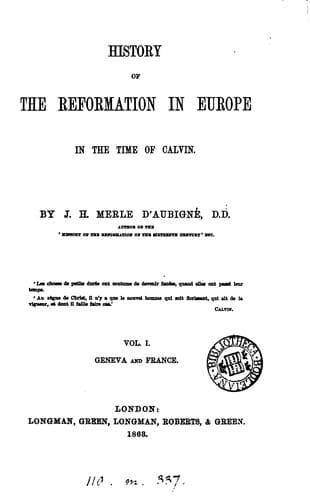
History of the Reformation in Europe in the Time of Calvin, Vol. 8 (of 8) — John Shaqi
History of the Reformation in Europe in the Time of Calvin, Vol. 8 (of 8)Merle d'Aubigné, J. H. (Jean Henri)
History
History of the Reformation in Europe in the Time of Calvin, Vol. 8 (of 8)
Merle d'Aubigné, J. H. (Jean Henri)
Reformation
even banished Manrique, the inquisitor-general, who was compelled to
retire to his diocese, and died there. Charles did more than this. He
addressed to the Holy Office, July 18, 1534, an ordinance prohibiting
the arrest of a monk before laying the evidence before the council
and awaiting its orders. But the emperor, all-powerful as he was, was
not powerful enough to snatch a victim from the Inquisition. Virves,
whose only crime was that of being a pious and moderate Catholic,
had to undergo for four years all the horrors of a secret prison.
He says himself that they hardly gave him leave to breathe. The
inquisitors overwhelmed him with accusations, with interdictions,
with libels and with words, he says, which one can not hear without
being terrified. He adds that he was charged with errors, heresies,
blasphemies, anathemas, schism, and other similar monstrosities. To
convince them, he undertook labors which might be likened to those
of Hercules. He exhibited the points which he had drawn up by way of
preparation for an attack on Melanchthon before the diet of Ratisbon.
But all was useless. The tribunal condemned him in 1537 to abjure all
heresies, among others those of Luther, to be confined in a monastery
for two years, and to abstain from preaching for two years after his
liberation. The poor man had to appear in the cathedral of Seville, and
to retract, among other propositions, the following:--'A life of action
is more meritorious than a life of contemplation.--A larger number of
Christians are saved in the married state than in all other states.'
Charles the Fifth, determined at all cost to rescue his chaplain from
imprisonment, applied to the pope, who by a brief of May 29, 1538,
ordered that Virves should be set at liberty, and be again allowed to
preach. Charles now nominated him bishop of the Canary Islands. After
some hesitation, the pope consented to the appointment, and in 1540,
the heretic was invested with the episcopal mitre. In the following
year he published at Antwerp his _Philippicæ Disputationes_, in which
his objections to the doctrines of Luther are set forth. In the same
book, however, he asserted that heretics ought not to be ill-used, but
persuaded, and this especially by setting before them the testimonies
of Holy Scripture; because _all Scripture given by inspiration of
God is profitable_, says St. Paul, _for doctrine, for reproof, for
correction_. Alfonso Virves was one of those Spaniards whom the
Inquisition prevented from becoming evangelical, but could not succeed
in making papistical and ultramontane.[41]
Public-domain text, read in full here on John Shaqi.
Reviews
Reviews
No reviews yet
Be the first to share your thoughts on this work.
Join the Discussion
Join the discussion
Sign in to leave a comment or review.
Sign InorCreate an account