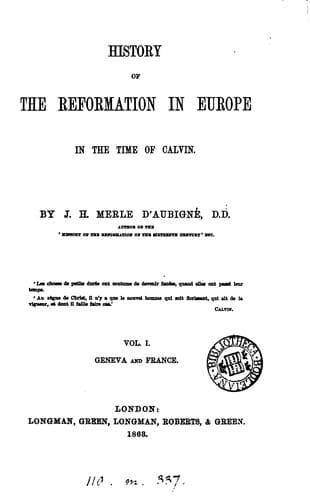
History of the Reformation in Europe in the Time of Calvin, Vol. 8 (of 8)Merle d'Aubigné, J. H. (Jean Henri)
History
History of the Reformation in Europe in the Time of Calvin, Vol. 8 (of 8)
Merle d'Aubigné, J. H. (Jean Henri)
Reformation
John d'Avila himself, the apostle of Andalusia, whose only thought was
the conversion of souls, and who did not meddle with controversies,
found that the monks, enraged and provoked by his refusal to engage
in disputation, denounced him to the Inquisition as a Lutheran or
_alumbrado_. In 1534, an inauspicious year for evangelical Spain, this
humble pastor was arrested at Seville, and cast into the prisons of the
holy office. But his enemies, impelled by blind hatred, had not even
informed the archbishop of Seville, Don Alfonso de Manrique, who was
at this time Grand Inquisitor. The prelate, who cherished the highest
esteem for John d'Avila, was affected on hearing what his subordinates
had just done. He pointed out that this man was no Lutheran, but was
only seeking to do good to the souls of men. D'Avila was consequently
acquitted, and he continued quietly to preach the Gospel till his
death. The inquisitors, by fastening the name 'Lutheran' on every thing
pious, rendered indirect homage to Lutheranism.[38]
[Sidenote: ALFONSO VIRVES.]
Manrique was not alone in occasional opposition to the fanaticism of
the inquisitors. Charles the Fifth himself, although strongly opposed
to every thing which appeared to him heresy, seems to have had some
relish for solid preaching. His fine understanding preferred it to the
fables of the monks. He had for his chaplain a Dominican monk named
Alfonso Virves, an accomplished orientalist and a good theologian.
Charles took him with him when he travelled in Germany; and he not only
liked to hear him preach, but also associated with him in his numerous
journeyings with a certain degree of intimacy. After his return to
Spain, the emperor would hear no other preacher. Certain monks who
coveted the privilege of preaching before the emperor were filled with
envy and hatred. They inveighed against Virves. In vain he contended,
according to the dictates of his conscience, for what he believed to
be true piety; these wretches uttered shameless calumnies against
him, and obvious falsehoods, and resorted to malicious intrigues.
This was their usual method.[39] Virves esteemed the fine genius of
Erasmus, but censured him for his too great freedom. He asserted that
his wish was to secure Spain against Lutheranism. But he had seen
in Germany the leading reformers, had enjoyed friendly intercourse
with them, and declared that he renounced the attempt to recall them
from their errors.[40] This was ground enough for a prosecution;
and without any regard to the wish of the emperor, the inquisitors
arrested his chaplain, threw him into the prison of the Holy Office
at Seville, and in eager haste prepared to sacrifice him. The news of
their proceedings reaching Charles the Fifth, he was astonished and
indignant. He was better acquainted with Virves than the inquisitors
were. He determined by energetic action to foil the conspiracies of the
monks. He felt confident that Virves was the victim of an intrigue. He
Public-domain text, read in full here on John Shaqi.
Reviews
Reviews
No reviews yet
Be the first to share your thoughts on this work.
Join the Discussion
Join the discussion
Sign in to leave a comment or review.
Sign InorCreate an account