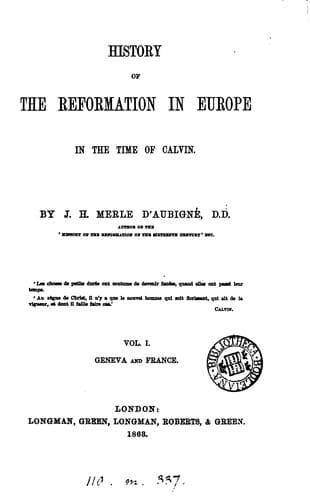
History of the Reformation in Europe in the Time of Calvin, Vol. 8 (of 8)Merle d'Aubigné, J. H. (Jean Henri)
History
History of the Reformation in Europe in the Time of Calvin, Vol. 8 (of 8)
Merle d'Aubigné, J. H. (Jean Henri)
Reformation
with them.' The wives and daughters of the prisoners had assembled in
a neighboring house. The door now opened, and they approached, some
smiting themselves on the breast, others with dishevelled[499] hair;
they cast themselves at the feet of the elector and entreated pardon
for these innocent men. Hermann, who was not cruel, could not refrain
from tears, and he granted the pardon which was sought at his hands.
Nevertheless, the evangelical doctrine was prohibited in the town. The
people were even forbidden to engage domestic servants who came from
places where the new doctrine was professed.[500]
We have elsewhere seen how some countries and towns more or less
recently reformed, had felt the need of union after the decree of the
diet of Augsburg, of 1530, and had formed at Smalcalde, March 29,
1531, an alliance for six years, by which they engaged to defend each
other.[501] Under these circumstances, and considering that the Sultan
Solyman was advancing towards Austria with an immense army, the Emperor
had determined to treat with the Protestants, and the religious peace
of Nürnberg was concluded, July 23, 1532. The leaguers of Smalcalde,
nevertheless, were still subject to molestation, for various reasons,
by the tribunals of the Empire. The landgrave of Hesse, by a bold
measure, re-established the Protestant duke, Ulrich of Würtemberg, in
his dominions, thus opening them to the Reformation and increasing the
power of the League of Smalcalde.[502]
CHAPTER III.
THE TRIUMPH OF THE ANABAPTISTS OF MUNSTER.
(1533.)
Unfortunately, there was going on at this time a fanatical movement,
which the Roman Catholics were fain to turn to account against the
Reformation, but which in truth furnished no ground of reproach against
it; for the attitude of the Reformation towards the fanatics was
chiefly one of resistance and suppression. When after a long winter the
springtide comes again, it is not only the good seed which grows up,
but weeds too appear in abundance. It could not happen otherwise in
this new springtide of the church, which is called the Reformation. The
mightiest power of the Middle Ages--the Papacy--was assailed. In place
of the opinions which it had professed and imposed on the world for
centuries, the reformers presented evangelical doctrine. It was easy to
understand that not all who rejected the views of the Roman pontiffs
would accept those of the reformers, but that many would invent or
adopt others.
Public-domain text, read in full here on John Shaqi.
Reviews
Reviews
No reviews yet
Be the first to share your thoughts on this work.
Elsewhere in the archive
Join the Discussion
Join the discussion
Sign in to leave a comment or review.
Sign InorCreate an account