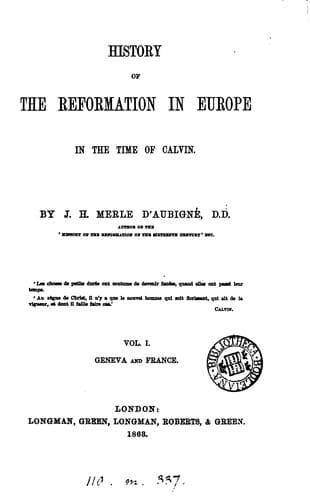
History of the Reformation in Europe in the Time of Calvin, Vol. 8 (of 8)Merle d'Aubigné, J. H. (Jean Henri)
History
History of the Reformation in Europe in the Time of Calvin, Vol. 8 (of 8)
Merle d'Aubigné, J. H. (Jean Henri)
Reformation
There was a diversity of doctrines, and sometimes, even within the
limits of a single party, all manner of opinions. This was the case
with the so-called _Spirituals_, who have been erroneously named
Anabaptists, for opposition to infant baptism, so far from being their
distinctive doctrine, was hardly their badge. They held in general the
power for good of the natural will (free-will). Haetzer denied the
divinity of Christ, and led a bad life. Many of them said, 'Christ
took nothing of human nature from his mother, for the Adamic nature is
accursed.' There were some who looked upon the observance of Sunday as
an antichristian practice. These fanatics fancied themselves alone to
be the children of God, and like the Israelites of old believed that
they were called to exterminate the wicked. One of this sect, Melchior
Hoffmann, after being in turn in kings' courts and in ignominious
imprisonment, went into Alsace, supposing that at Strasburg the new
Jerusalem was to come down from heaven, and that from this town would
go forth the messengers charged to gather together God's elect. Almost
all of them expected that the end of the world was very near at hand,
and some even fixed the day and the hour.
[Sidenote: BERNARD ROTTMANN.]
These fanatics, in consequence of the persecution to which they were
subjected in South Germany, in Switzerland, and in Holland, turned
their steps towards the regions bordering on the Rhine, where more
freedom was to be enjoyed, and where the Reformation was not yet
thoroughly organized. Munster, in Westphalia, was a strong town,
fortified with a citadel, and the seat of a bishop, with a cathedral,
and a numerous body of clergy. Near the town stood a church dedicated
to St. Maurice; here a false reformer preached a false reformation.
This preacher was one Bernard Rottmann, a fiery man, eloquent and
daring, who had to some extent apprehended the reformed doctrine,
but whose heart remained unaffected by it. As he used to deliver
fine discourses, the townspeople flocked to hear him; and at length
requested that he should be called into Munster. Some influential men
among the Roman Catholics, acquainted with the man, and anxious to
avoid any disturbance, offered him money to go away.[503] Rottmann
accepted the money and took his departure, thus giving the measure of
his faith and zeal. He then visited several towns and universities
in Germany, but made no stay anywhere, and in the course of a few
months returned to Munster. Some of the citizens and the populace,
who were very fond of listening to his declamation, joyfully welcomed
him; but the bishop and the clergy were opposed to his preaching
in the churches. His partisans now set up a pulpit for him in the
market-place, and his hearers increased in number daily. Two pastors
from Hesse, taking Rottmann for a minister of good standing, joined
him, and drew up a statement of the errors of Rome in thirty-one
articles, and submitted it to the council. The priests were then
Public-domain text, read in full here on John Shaqi.
Reviews
Reviews
No reviews yet
Be the first to share your thoughts on this work.
Elsewhere in the archive
Join the Discussion
Join the discussion
Sign in to leave a comment or review.
Sign InorCreate an account