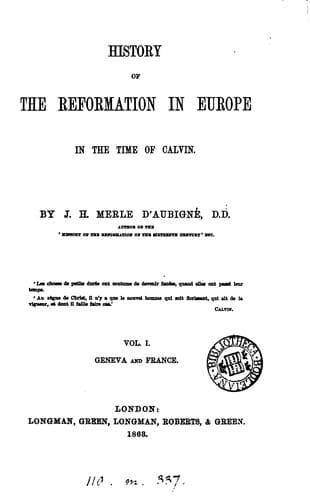
History of the Reformation in Europe in the Time of Calvin, Vol. 8 (of 8)Merle d'Aubigné, J. H. (Jean Henri)
History
History of the Reformation in Europe in the Time of Calvin, Vol. 8 (of 8)
Merle d'Aubigné, J. H. (Jean Henri)
Reformation
assembled at the town-hall, and the council laid the document before
them. 'This is indeed our doctrine,' they said, 'but we are not
prepared to defend it.' They were consequently deprived. The bishop,
who had quitted Munster, resolved to cut off the supply of food to the
town--a measure not exactly within a pastor's function, whose call is
to feed his flock. The townsmen, provoked, arrested most of the canons
and the priests and imprisoned them; and it was arranged in 1533, that
evangelical doctrine should be preached in the six churches of the
town, and that the old abuses should be no longer allowed except in the
cathedral.[504]
Among the most respected inhabitants of Munster was the syndic Wiggers,
whose wife, continually followed by a host of admirers, was a person
of doubtful character. She had a great admiration for Rottmann, and,
clever woman as she was, knew how to captivate him. Her husband died
shortly afterwards, and the rumor was spread that she had poisoned
him.[505] This is, however, uncertain. Whatever the fact may be,
Rottmann married her, and thus showed again, that although he was a
preacher of the Gospel, he did not practise it. Honorable men now
withdrew from his society. This circumstance, with others, drove him to
take an extreme course.
In 1533 a very large number of enthusiasts from the Netherlands arrived
at Munster. One of these, Stapreda, from Meurs, became Rottmann's
colleague, and preached vigorously their particular doctrines.[506]
Rottmann, abandoned by his old friends, threw himself into the arms
of these new ones, and strongly advocated their views. Great alarm
was excited in Hesse. Hermann Busch, of Marburg, came to Munster to
oppose the fanatics, and in consequence of a dispute between him and
Rottmann the adherents of the latter received orders to leave the town.
They concealed themselves for a time and then reappeared. The pastor
Fabritius, sent to Munster by the landgrave of Hesse, who was growing
more and more alarmed, earnestly exhorted the senate and the people to
be steadfast in sound doctrine. But one of the visionaries, pretending
to be led by divine inspiration, went about the town towards the end of
December, 1533, exclaiming: 'Repent ye and be baptized, or the wrath of
God will destroy you.'[507] Ignorant men were filled with terror and
hastened to obey.
[Sidenote: MATTHISSON AND BOCKHOLD.]
Public-domain text, read in full here on John Shaqi.
Reviews
Reviews
No reviews yet
Be the first to share your thoughts on this work.
Elsewhere in the archive
Join the Discussion
Join the discussion
Sign in to leave a comment or review.
Sign InorCreate an account